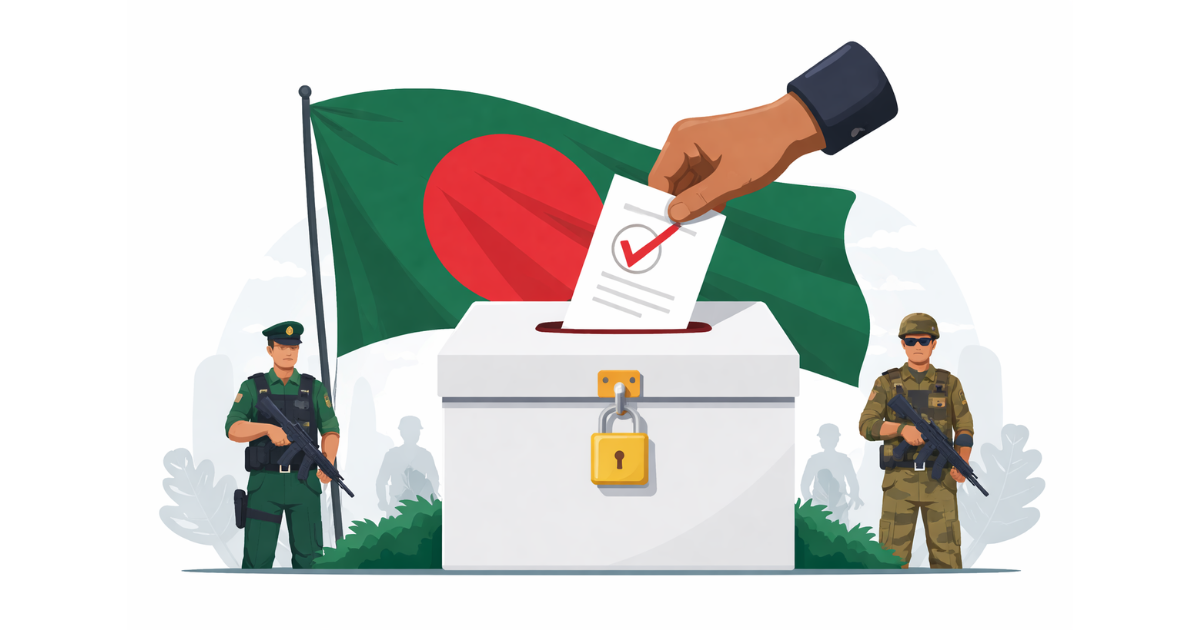
DHAKA — February 12, 2026 — Voting is underway across Bangladesh in what is widely seen as the most crucial parliamentary election in the country’s recent history. Polling for the 13th National Parliament began early this morning, with over 127 million eligible voters casting their ballots across more than 42,000 polling stationsnationwide.
This is the first general election since the 2024 mass uprising that led to the exit of former Prime Minister Sheikh Hasina. The outcome will decide who forms the next government and how Bangladesh moves forward after a period of political unrest and transition.
For India and the wider South Asian region, the election carries strategic and economic importance. Political stability in Dhaka directly impacts trade, security cooperation, and regional diplomacy.
Why Bangladesh Elections 2026 Matter
The 2026 Bangladesh election marks a turning point for the country’s democratic future. After years of political tension, protests, and demands for electoral reforms, this vote is seen as a test of institutional strength and public trust.
The election will determine the composition of the 350-member Jatiya Sangsad (National Parliament). Of these, 300 members are directly elected, while 50 seats are reserved for women and allocated proportionally.
Millions of first-time voters are participating in this election. Young voters, in particular, are expected to play a key role in shaping the outcome.
The Election Commission has stated that voting will continue through the day, and results are expected on February 13, 2026.
Election Day Snapshot: Key Numbers
Election Date: February 12, 2026
Eligible Voters: 127 million+
Total Seats: 350
Polling Stations: 42,000+
Security Personnel Deployed: Around 950,000
Polling began early in the morning and will continue until late afternoon. Officials have reported steady voter movement in major cities including Dhaka, Chattogram, Khulna, and Rajshahi.
Key Candidates and Political Forces in the Race
The political landscape has shifted significantly since 2024. Several major players are competing to form the next government.
Tarique Rahman and the Bangladesh Nationalist Party (BNP)
Tarique Rahman, a central figure in the Bangladesh Nationalist Party, is one of the most prominent leaders in this election. After years away from frontline politics, his return has energized party supporters.
The BNP has campaigned on promises of democratic reform, accountability, and economic recovery. The party is seeking to capitalize on public demand for political change following the 2024 upheaval.
Observers note that BNP’s performance in urban constituencies could be crucial in determining overall results.
Jamaat-e-Islami and Allied Groups
Jamaat-e-Islami and its allies are also contesting strongly in several constituencies. The party has maintained influence in certain regions and is positioning itself as an alternative force.
Political analysts say that alliances and seat-sharing arrangements may play a decisive role in close contests.
Interim Government Under Muhammad Yunus
The election is being conducted under a transitional administration led by Nobel laureate Muhammad Yunus. The interim government took charge after the 2024 political transition.
Authorities have repeatedly stated that the aim is to ensure a free, fair, and transparent election process. The credibility of this administration is closely linked to how smoothly voting and counting are conducted.
Massive Security Deployment Across the Country
Security has been one of the biggest focus areas for the Bangladesh Elections 2026.
Around 9.5 lakh security personnel have been deployed across the country. This includes members of the Army, Police, Border Guard Bangladesh, Coast Guard, and other forces.
Officials describe the security plan as multi-layered. Static forces are stationed at polling booths, while mobile patrol units are active in surrounding areas.
Sensitive and high-risk polling centres have received additional protection. Authorities have said that rapid response teams are on standby to address any incidents.
Technology in Monitoring
Election authorities have introduced enhanced monitoring systems this year.
A large number of polling centres are under CCTV surveillance. Security personnel are also equipped with body-worn cameras in many locations.
Officials say these steps are meant to increase transparency and deter violence.
Reports of Tension and Clashes
While polling has largely remained peaceful in many parts of the country, there have been isolated reports of clashes between rival supporters in certain areas.
Election authorities have urged political parties to maintain calm and allow voters to exercise their democratic rights without fear.
Civil society groups are closely monitoring the situation. International observers are also present in various constituencies to oversee the process.
Voter Turnout and Public Mood
Early visuals from polling booths show voters lining up in several regions. Women and elderly voters have been seen arriving early in the day.
Turnout figures will be updated periodically by the Election Commission. High voter turnout could indicate strong public engagement in this post-Hasina transition phase.
In rural areas, local administration officials report smooth arrangements. In urban centres, traffic management and security checks have been intensified.
What Happens After Voting Ends
Once polling closes, ballot boxes will be secured and transported under tight security for counting.
Counting is expected to begin soon after voting ends, and trends may emerge later tonight. However, the final official results are expected on February 13, 2026.
If no single party secures a clear majority in the 300 directly elected seats, coalition talks may begin.
Why Indian Readers Should Watch Closely
Bangladesh is one of India’s closest neighbours and a key trade partner. Political developments in Dhaka affect cross-border trade, connectivity projects, and regional security cooperation.
A stable government in Bangladesh is important for ongoing infrastructure projects, energy partnerships, and border management.
Indian policymakers and businesses will closely track the outcome and its impact on bilateral ties.
A Defining Moment for Bangladesh’s Democracy
The Bangladesh Elections 2026 are more than a routine vote. They represent a critical chapter after a major political shift in 2024.
The credibility of the electoral process, the peaceful conduct of voting, and the acceptance of results will shape Bangladesh’s democratic future.
For millions of voters, today is about choosing stability, reform, and direction for the next five years.
As ballots are cast and counting approaches, the nation — and the region — watches closely.
Stay tuned for the latest Bangladesh Elections 2026 LIVE updates, voter turnout data, and final results as they are officially announced.
Disclaimer: The information presented in this article is intended for general informational purposes only. While every effort is made to ensure accuracy, completeness, and timeliness, data such as prices, market figures, government notifications, weather updates, holiday announcements, and public advisories are subject to change and may vary based on location and official revisions. Readers are strongly encouraged to verify details from relevant official sources before making financial, investment, career, travel, or personal decisions. This publication does not provide financial, investment, legal, or professional advice and shall not be held liable for any losses, damages, or actions taken in reliance on the information provided.
About The Author