
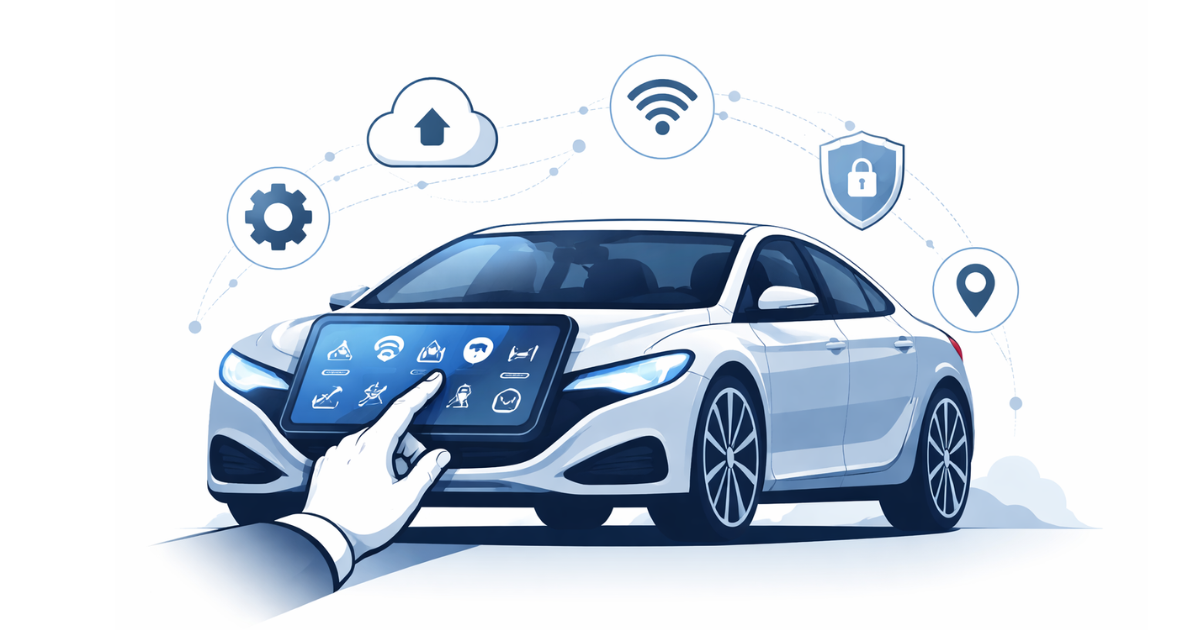
India’s car market is entering a new phase where the “best vehicle” is no longer defined only by engine size, metal strength, or cabin space. Increasingly, buyers are judging cars like smartphones on wheels—devices that can improve over time through software updates, new features, and personalised settings.
A recent India cut of the 2026 Deloitte Global Automotive Consumer Study captures how fast this mindset is spreading. Deloitte India said 95% of surveyed consumers are willing to pay for software-defined vehicle (SDV) capabilities, especially features linked to safety, security and continuous vehicle-health reporting.
That figure does not mean 95% of buyers are already purchasing SDVs today, or that every new car sold is “software-defined.” What it does show—very clearly—is that software-led value is now a mainstream expectation, not a niche preference in India’s passenger vehicle market.
What “software-defined” really means in a car
A software-defined vehicle is built around the idea that software, not hardware, becomes the main driver of features and upgrades. Instead of being “locked” at the time of purchase, many functions can evolve through over-the-air updates—ranging from user-interface improvements to safety alerts, diagnostics, and new driver assistance capabilities.
Industry and policy discussions increasingly describe SDVs alongside trends like connectivity, advanced safety features, electrification and the growing role of AI and data in mobility.
In practical terms, buyers are looking for cars that can keep improving without a new purchase cycle—through smarter infotainment, better navigation, improved energy efficiency, predictive maintenance, and software-enabled safety features.
Why “software value” is winning over “hardware value”
The Deloitte India findings point to a broader shift: vehicle value is moving from hardware-centric ownership towards connected, upgradeable, service-driven mobility.
This shift is happening for a few reasons that are specific to how Indians buy and use cars.
First, the gap between “basic” and “premium” is no longer only about materials or horsepower. Many buyers now see premium as technology depth—the kind that can be updated, personalised and secured.
Second, software reduces the fear of early obsolescence. A car that can receive meaningful updates feels more future-proof, which matters in a market where ownership cycles are often long and resale value is important.
Third, SDVs help manufacturers deliver visible improvements after purchase—something that fits India’s digital behaviour, where consumers are already used to apps and operating systems becoming better over time.
Safety and vehicle health are the strongest selling points
One important detail in Deloitte’s India release is what people are willing to pay for. The demand is not being led only by “convenience tech.” Deloitte highlights safety, security and continuous vehicle-health reporting as major SDV value drivers for Indian consumers.
That is a meaningful signal for automakers. It suggests the strongest subscription and paid-feature potential in India may sit in protective services—alerts, monitoring, diagnostics and security—rather than only entertainment upgrades.
AI features are gaining acceptance, but trust is still the big battleground
The same study also points to a rising openness to AI-led features. Deloitte India reported that 81% of consumers find SDVs helpful, and 84% are willing to adopt AI-enabled vehicle customisation.
At the same time, India stands out for its anxiety about data. Deloitte’s release notes that 73% are concerned about sharing personal device data and 72% are concerned about sharing vehicle location data in connected-vehicle contexts.
This creates a defining tension in the SDV era: buyers want always-connected, always-improving cars, but they also want strong safeguards around what data is collected, where it goes, and who can use it.
For automakers, that makes trust a product feature. Clear consent controls, transparent data policies, and cybersecurity investments are becoming as important as the screen size on the dashboard.
Even in a software-first era, dealerships still matter
A common assumption is that digitisation will reduce the role of dealers. The India findings argue the opposite—at least for now.
Deloitte notes that 58% of consumers trust dealers the most, and that India shows high reliance on authorised dealerships for servicing.
That matters because SDVs change service expectations. Updates and diagnostics may happen remotely, but buyers still want a trusted physical touchpoint when something feels wrong, when features fail, or when they need help understanding new capabilities.
In other words, the next phase of car ownership in India is likely to be phygital: software-led experiences supported by strong on-ground networks.
What Indian buyers still care about—quality and performance haven’t disappeared
The shift toward SDVs is not replacing traditional purchase drivers; it is adding a new layer.
In the same release, Deloitte India lists product quality (58%), vehicle performance (57%), and in-vehicle technology (50%) as top purchase drivers.
This is important context for understanding the SDV moment. Indian consumers are not saying “hardware doesn’t matter.” They are saying hardware alone is no longer enough.
A well-built car without meaningful software experiences can feel incomplete in a market where buyers increasingly expect connected features, continuous upgrades, and intelligent safety layers.
The SDV shift is happening even as EV adoption stays measured
Another key takeaway from Deloitte’s India release is that this “software-first” appetite is rising even though electric vehicle adoption intent is progressing steadily, not sharply.
The study points to common EV constraints—public charging availability, charging time, and battery-related concerns—showing that powertrain transition has its own friction points.
That creates an interesting near-term reality: India can become increasingly “software-defined” even with a large base of internal combustion and hybrid vehicles. In fact, connected services, diagnostics, and safety software can scale across powertrains—making SDVs a broader transformation than EVs alone.
What this means for carmakers and the auto industry
For manufacturers, SDVs are not just a product strategy; they are a business model shift.
Software-led architectures can enable feature upgrades, subscriptions, bundled safety services, and direct relationships with customers long after the vehicle leaves the showroom. Deloitte’s India findings also highlight openness to new engagement models, including interest in purchasing insurance directly from manufacturers.
But the “software economy” of cars will only grow if trust grows with it. With high consumer concern around data sharing, companies that treat privacy and security as core design principles—not legal footnotes—may win the loyalty battle in the SDV era.
The bottom line
India’s car market is not abandoning hardware; it is redefining what hardware must deliver.
The strongest signal from recent consumer research is that software-led capability—especially safety, security, and vehicle health—has become a mainstream expectation, with Deloitte reporting 95% willingness to pay for SDV features among surveyed Indian consumers.
As automakers race to build cars that improve over time, the winners in India may be those who get three things right at once: dependable build quality, genuinely useful software upgrades, and a trust framework that makes connected driving feel safe.
Disclaimer: The information presented in this article is intended for general informational purposes only. While every effort is made to ensure accuracy, completeness, and timeliness, data such as prices, market figures, government notifications, weather updates, holiday announcements, and public advisories are subject to change and may vary based on location and official revisions. Readers are strongly encouraged to verify details from relevant official sources before making financial, investment, career, travel, or personal decisions. This publication does not provide financial, investment, legal, or professional advice and shall not be held liable for any losses, damages, or actions taken in reliance on the information provided.
About The Author