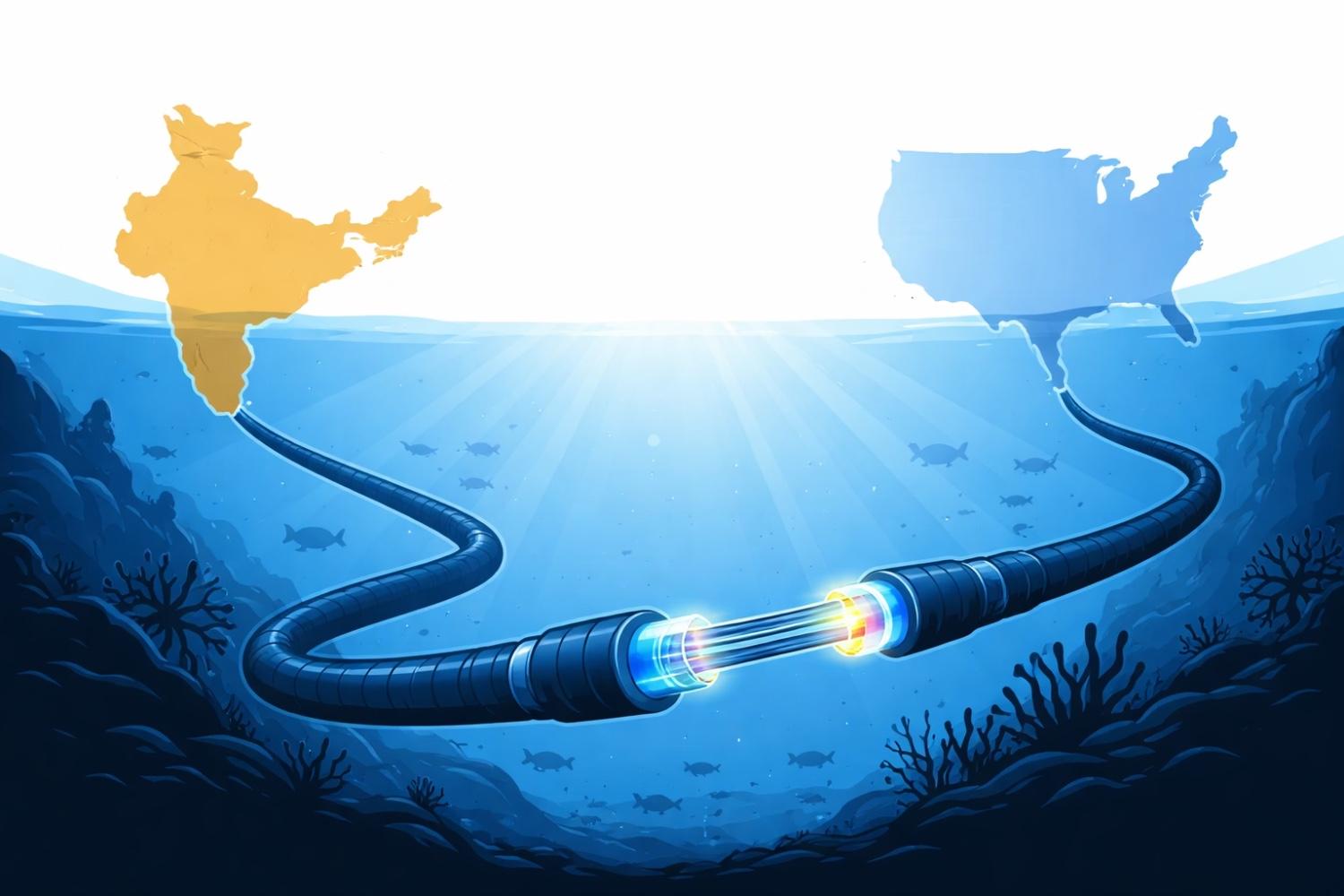
Google’s new America-India Connect subsea cable project is set to strengthen India’s global internet links, improve data speed, and support the country’s fast-growing digital economy. At a time when India is adding millions of new internet users every year and expanding its digital services, this undersea cable project could play a key role in shaping the country’s internet future.
Subsea cables carry more than 95 percent of global internet traffic. For India, which depends heavily on international data routes for cloud services, financial transactions, video streaming and digital payments, stronger connectivity to the United States is strategically important. Google’s move signals long-term investment in India’s digital infrastructure.
What Is the America-India Connect Project?
The America-India Connect Project is a subsea internet cable initiative led by Google to enhance direct data connectivity between India and the United States. Submarine cables are laid on the ocean floor and transmit data through fiber-optic technology at extremely high speeds.
Google has been investing in global internet infrastructure for over a decade. The company has either invested in or built several international subsea cable systems to improve performance and reliability for its users and cloud customers worldwide.
With this new link between the US and India, the focus is on creating a faster and more resilient digital corridor between two of the world’s largest technology markets.
Why Subsea Cables Matter for India
India is now one of the largest internet markets in the world. With over 800 million internet users and growing demand for streaming, gaming, digital payments, artificial intelligence services and cloud computing, the pressure on data networks continues to rise.
Most international internet traffic from India currently travels through complex routes that connect to Europe, the Middle East or Southeast Asia before reaching the United States. A more direct and high-capacity route can help reduce latency, which means lower delay in data transfer.
Lower latency is important for sectors such as financial trading, video conferencing, real-time gaming, telemedicine and enterprise cloud services. Faster international connectivity also supports India’s startup ecosystem and technology exports.
Google’s Expanding Infrastructure in India
Google has steadily increased its investment in India over the past few years. Under its broader digital investment plans, the company has expanded data centers, cloud regions and digital partnerships in the country.
Google Cloud has established cloud regions in India to serve businesses and public sector organisations. These local data centers reduce dependency on overseas servers and improve data processing speed within India.
The America-India Connect cable aligns with Google’s global strategy of building secure and reliable internet infrastructure. It also supports the company’s cloud computing ambitions in India, where demand from enterprises and government departments is rising.
Impact on India’s Digital Economy
India’s digital economy is expanding rapidly. According to government and industry estimates, digital services now contribute a growing share to the country’s GDP. Sectors such as fintech, e-commerce, edtech, health tech and digital media depend heavily on stable international connectivity.
A stronger subsea cable network can help:
Improve reliability during traffic surges
Support growing cloud adoption
Enhance cross-border digital trade
Boost AI and data-heavy services
As more Indian businesses rely on global clients, smoother data exchange between India and the US becomes critical. The United States remains one of India’s largest technology and services markets.
Boost for Data Centres and Cloud Services
India is emerging as a major data centre hub in Asia. Cities such as Mumbai, Chennai and Hyderabad have seen strong growth in hyperscale data centre capacity. Global cloud providers including Google are expanding their footprint.
Subsea cables play a direct role in attracting data centre investments. Reliable international bandwidth makes India more attractive for global companies to store and process data locally.
For Indian companies using Google Cloud services, better connectivity can improve performance for applications hosted in India but serving global users.
Strategic Importance for India-US Relations
Digital infrastructure has become an important part of India-US economic cooperation. Both countries have been deepening ties in technology, semiconductors, artificial intelligence and cybersecurity.
A dedicated subsea cable route strengthens the digital backbone between the two nations. It reduces reliance on third-country routes and improves network resilience.
In recent years, both governments have highlighted the importance of secure and trusted digital infrastructure. Private sector investments, including subsea cables, complement broader policy cooperation.
Network Reliability and Redundancy
Undersea cables can sometimes face disruptions due to natural events, ship anchors or technical issues. That is why redundancy is important.
By adding more routes and capacity, companies reduce the risk of large-scale internet slowdowns during cable cuts or maintenance work. For India, which has faced occasional international bandwidth disruptions in the past, additional cables improve stability.
More routes also help distribute traffic evenly and manage peak demand during major events such as online sales festivals or global live streaming.
How This Affects Everyday Users
For most Indian users, the impact may not be immediate or visible. Internet speed at home depends largely on local broadband providers and last-mile infrastructure.
However, over time, stronger international connectivity can lead to better video quality, faster cloud backups, smoother international calls and more reliable access to global platforms.
Businesses, startups and developers are likely to benefit the most in the short term, especially those serving overseas clients.
Competition in Global Subsea Cable Investments
Google is not the only technology company investing in subsea cables. Other global firms have also funded large-scale projects to control network performance and reduce dependence on traditional telecom operators.
Owning or co-owning cable infrastructure allows tech companies to manage traffic more efficiently and support their growing cloud businesses.
For India, this competition means greater investment in digital infrastructure and improved connectivity options.
Alignment with India’s Digital Vision
India has placed strong emphasis on digital transformation under initiatives such as Digital India. The government has promoted broadband expansion, data center growth and digital payments infrastructure.
Improved international connectivity complements these goals. As India aims to become a global technology hub and a major exporter of digital services, strong cross-border data links are essential.
The subsea cable project supports India’s ambition to move higher in the global digital value chain.
Environmental and Regulatory Aspects
Subsea cable projects typically require multiple regulatory approvals in different countries. Environmental assessments are also conducted to minimise impact on marine ecosystems.
Globally, cable operators follow international standards to ensure safe installation and maintenance. The long-term reliability of these cables depends on careful route planning and monitoring.
What Happens Next
Large subsea cable projects take time to build and become operational. They involve route surveys, manufacturing of fiber optic cables, laying operations and landing station construction.
Once operational, capacity is gradually activated based on demand. Internet service providers and enterprises then lease bandwidth to improve their services.
Industry experts expect continued investment in subsea cables as global data consumption rises sharply each year.
The Bigger Picture for India
India’s internet future depends not only on local broadband expansion but also on strong global connections. With rising data consumption, artificial intelligence workloads and cross-border digital trade, international bandwidth is becoming more important than ever.
Google’s America-India Connect Project reflects confidence in India’s digital growth story. It underlines the country’s position as a key technology market and a major hub for global digital services.
For Indian users, the benefits may unfold gradually. For businesses and the broader economy, the impact could be significant over the coming years.
As India moves deeper into the digital era, investments in invisible infrastructure such as subsea cables will quietly shape the speed, reliability and resilience of the country’s internet ecosystem.
The new America-India Connect cable is not just a technical project. It is a strategic step in strengthening India’s global digital links and preparing the country for the next phase of internet growth.
Disclaimer: The information presented in this article is intended for general informational purposes only. While every effort is made to ensure accuracy, completeness, and timeliness, data such as prices, market figures, government notifications, weather updates, holiday announcements, and public advisories are subject to change and may vary based on location and official revisions. Readers are strongly encouraged to verify details from relevant official sources before making financial, investment, career, travel, or personal decisions. This publication does not provide financial, investment, legal, or professional advice and shall not be held liable for any losses, damages, or actions taken in reliance on the information provided.
edited by D Rishidhar Reddy
About The Author