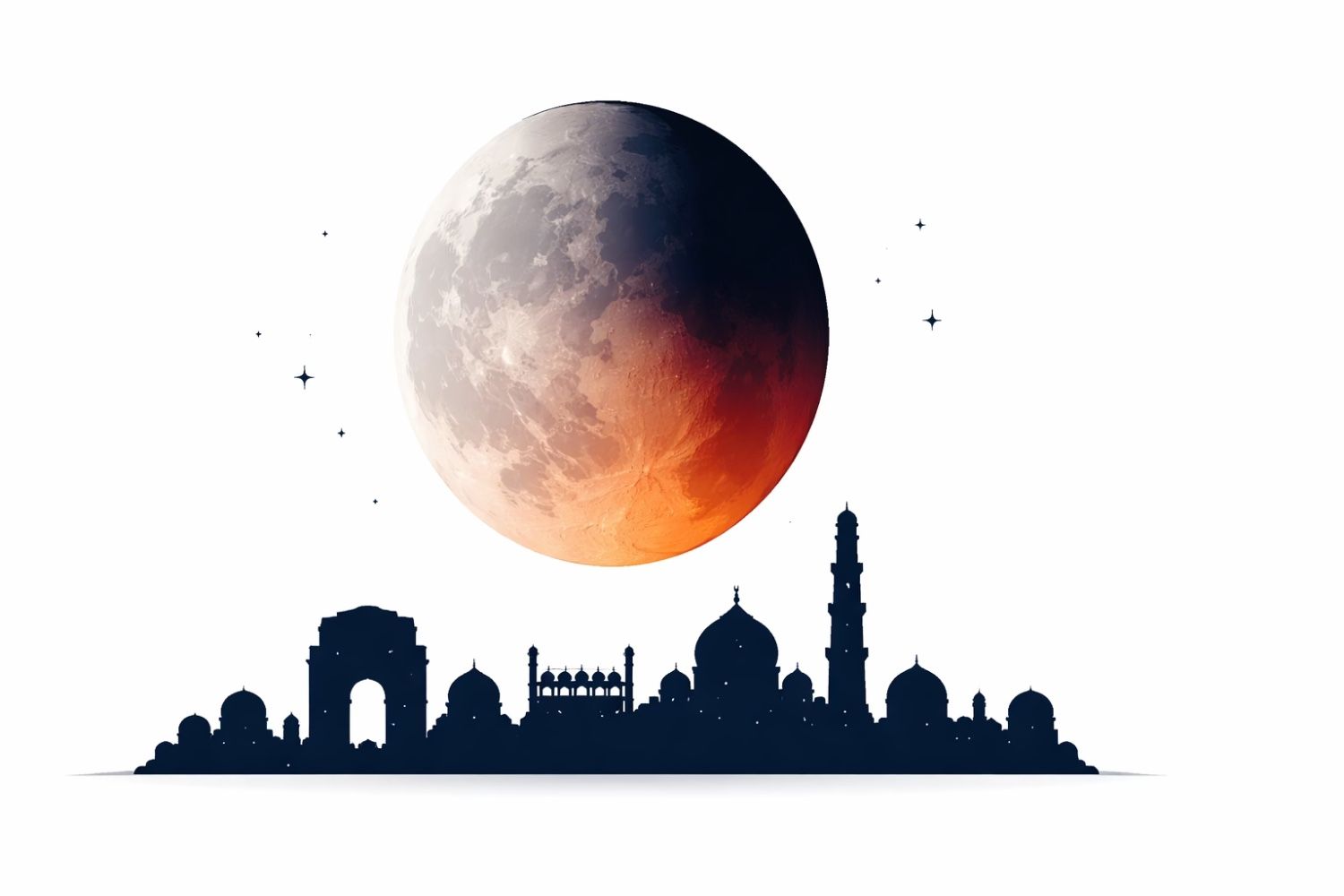
Chandra Grahan 2026 will be observed on March 3, 2026, and skywatchers across India are preparing for this important astronomical event. A lunar eclipse always draws attention because it is easy to see with the naked eye and carries both scientific and cultural importance.
Unlike a solar eclipse, a lunar eclipse does not require special viewing tools. It is safe to watch without protective glasses. This makes it one of the most widely observed celestial events in India.
Here is a complete guide covering Chandra Grahan 2026 timing in India, visibility details, best cities for viewing, and important safety tips.
What Is a Chandra Grahan?
A Chandra Grahan, or lunar eclipse, occurs when the Earth comes between the Sun and the Moon. The Earth blocks sunlight from reaching the Moon. As a result, the Moon appears darker and may turn a reddish shade during certain phases.
There are three main types of lunar eclipses:
- Penumbral Lunar Eclipse – The Moon passes through Earth’s outer shadow and becomes slightly dim.
- Partial Lunar Eclipse – A part of the Moon moves into Earth’s darker shadow.
- Total Lunar Eclipse – The entire Moon moves into Earth’s darkest shadow and may appear red.
The exact type of eclipse visible on March 3, 2026, will determine how dramatic the sky event appears across India.
Chandra Grahan 2026 Date and Timing in India
According to astronomical calculations, Chandra Grahan 2026 will occur on Tuesday, March 3, 2026.
The precise timings may vary slightly depending on location. Lunar eclipses usually unfold over several hours. The key stages include:
- Penumbral eclipse begins
- Partial eclipse begins
- Maximum eclipse
- Partial eclipse ends
- Penumbral eclipse ends
Because India follows Indian Standard Time (IST), viewers across the country will observe the event within a similar time window.
For accurate local timing, people are advised to check updates from official astronomical institutions closer to the date.
Will Chandra Grahan 2026 Be Visible in India?
Visibility depends on whether the Moon is above the horizon during the eclipse.
If the eclipse occurs during nighttime in India, it will be visible in most parts of the country, provided the sky is clear.
If the event happens during the daytime in India, it will not be visible because the Moon will not be in the night sky.
Based on current astronomical predictions for early March 2026, parts of Asia are expected to witness the eclipse. Final confirmation of visibility will be available closer to the event date.
Best Cities in India to Watch Chandra Grahan 2026
If weather conditions remain clear, the lunar eclipse can be viewed from most major Indian cities.
Some of the best locations include:
- Delhi
- Mumbai
- Kolkata
- Chennai
- Bengaluru
- Hyderabad
- Pune
- Ahmedabad
- Jaipur
- Lucknow
Cities with lower air pollution and clearer skies may offer better viewing conditions. Coastal regions and areas with open horizons often provide a clearer view of the Moon.
Hill stations and rural areas away from city lights may offer an even better experience.
How to Watch Chandra Grahan Safely
One of the most common questions during any eclipse is about safety.
Watching a lunar eclipse is completely safe with the naked eye.
There is no risk of eye damage because you are not looking at the Sun.
Here are a few useful tips:
- No special glasses are required.
- Binoculars or a telescope can enhance the view.
- Use a tripod if taking photos.
- Find an open area with a clear eastern or western horizon.
- Avoid areas with heavy light pollution.
Unlike a solar eclipse, there is no scientific restriction on viewing a lunar eclipse.
Cultural and Religious Significance in India
In India, a Chandra Grahan has cultural and religious importance.
Many people observe fasting during the eclipse. Some temples may close temporarily. Certain traditions advise avoiding food during the eclipse period.
The period called Sutak is observed in some households before the eclipse begins. The timing of Sutak depends on the type of eclipse and local customs.
It is important to note that these practices are based on tradition and belief. Scientifically, there is no harmful effect associated with a lunar eclipse.
Why Lunar Eclipses Are Important for Astronomy
Lunar eclipses help scientists study Earth’s atmosphere.
When the Moon turns reddish during a total eclipse, the color comes from sunlight passing through Earth’s atmosphere. Dust and particles in the atmosphere affect how the Moon appears.
Astronomers also use lunar eclipses to study:
- Orbital motion of the Moon
- Earth’s shadow size
- Atmospheric conditions
Because the event is visible from large parts of the Earth, it allows coordinated global observations.
Weather Conditions and Viewing Tips for March 3
March in India usually brings changing weather patterns.
Northern India may experience mild spring conditions. Southern India may have clearer skies in many regions. However, fog or clouds can affect visibility in some states.
For the best experience:
- Check local weather forecasts a day before the eclipse.
- Choose a rooftop, terrace, or open ground.
- Reach the location at least 20–30 minutes before the eclipse begins.
Photography enthusiasts may want to use a DSLR camera with a zoom lens to capture the different stages of the eclipse.
Difference Between Solar and Lunar Eclipse
Many readers often confuse the two.
A solar eclipse happens during the day when the Moon blocks the Sun. It requires protective glasses.
A lunar eclipse happens at night when Earth blocks sunlight from reaching the Moon. It is safe to watch.
Solar eclipses are visible only in limited areas. Lunar eclipses can be seen from anywhere on the night side of Earth.
How Often Do Lunar Eclipses Occur?
Lunar eclipses usually occur two to five times per year worldwide. However, not all of them are visible from India.
Some years may have no visible lunar eclipse from India due to timing and geography.
That is why each Chandra Grahan becomes a widely searched event online.
What to Expect During the Maximum Phase
If the eclipse reaches a strong partial or total phase visible in India, viewers may notice:
- A gradual darkening of the Moon
- A shadow moving across the lunar surface
- A reddish or copper tone during deeper phases
The maximum eclipse stage is usually the most visually striking moment.
Digital and Social Media Interest
Every major eclipse leads to a spike in Google searches. Keywords like “Chandra Grahan 2026 timing,” “lunar eclipse March 3 India,” and “Is lunar eclipse visible in India?” often trend before the event.
Experts advise readers to rely only on trusted scientific sources for timing updates.
Final Advisory for March 3, 2026
As March 3 approaches, viewers are encouraged to:
- Confirm official timing from reliable astronomical institutions.
- Check visibility status for their city.
- Monitor local weather updates.
- Avoid spreading unverified information.
The Chandra Grahan 2026 offers both a scientific spectacle and a culturally significant moment for millions across India.
If the skies remain clear, it will be a memorable night for astronomy enthusiasts and families alike.
Stay updated as the date gets closer for confirmed visibility and exact timing in IST.
The Moon will rise as usual. But for a few hours, it may tell a different story in the night sky.
Disclaimer: The information presented in this article is intended for general informational purposes only. While every effort is made to ensure accuracy, completeness, and timeliness, data such as prices, market figures, government notifications, weather updates, holiday announcements, and public advisories are subject to change and may vary based on location and official revisions. Readers are strongly encouraged to verify details from relevant official sources before making financial, investment, career, travel, or personal decisions. This publication does not provide financial, investment, legal, or professional advice and shall not be held liable for any losses, damages, or actions taken in reliance on the information provided.
edited by D Rishidhar Reddy
About The Author