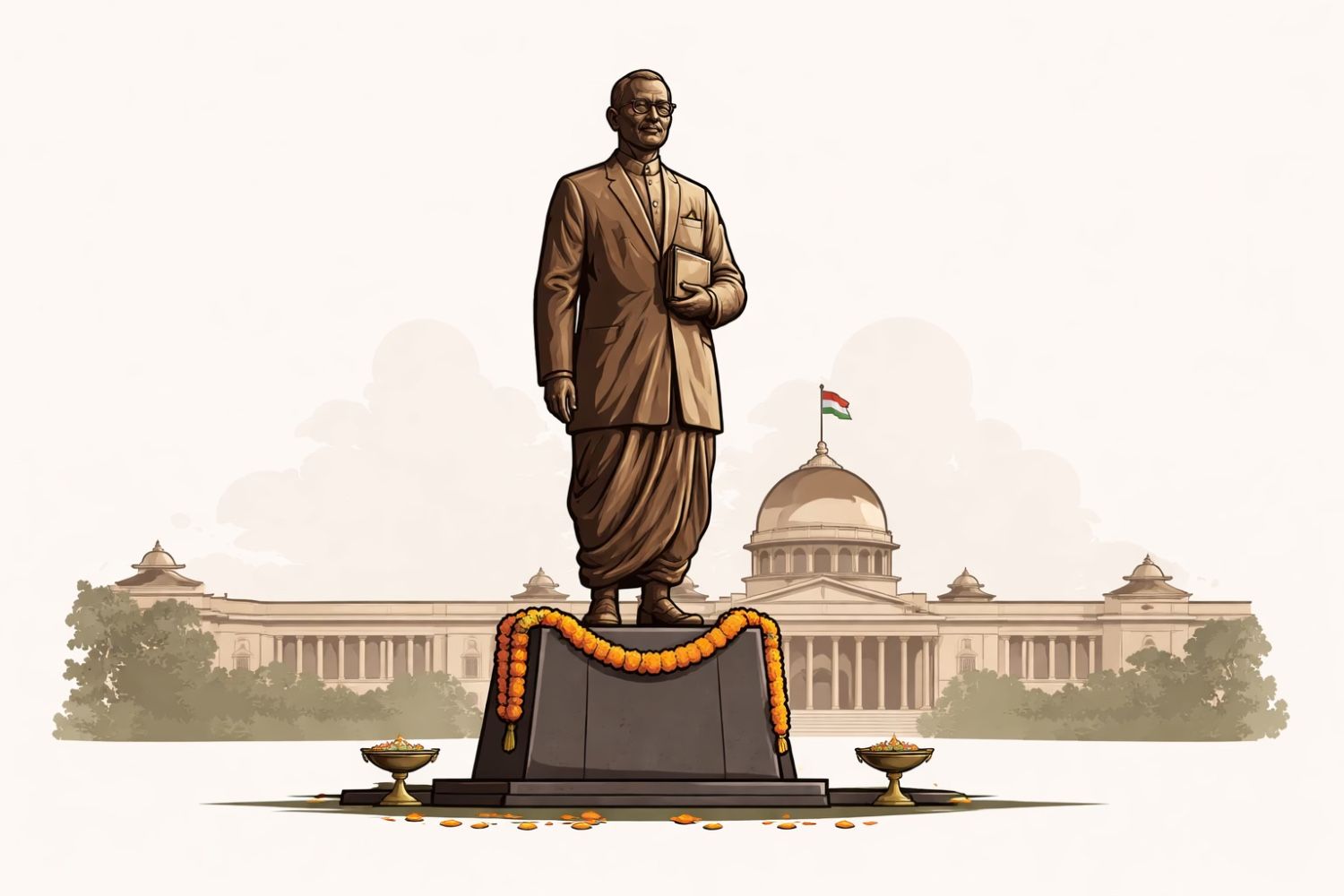
New Delhi: A significant change at Rashtrapati Bhavan has sparked nationwide discussion. The statue of C. Rajagopalachari, India’s last Governor-General, has replaced that of Edwin Lutyens, the British architect who designed the Viceroy’s House during colonial rule.
The move is more than a symbolic reshuffle of statues. It reflects how India continues to reinterpret its history, reclaim public spaces, and redefine the icons that represent its identity.
For many observers, this development marks another step in the country’s effort to place Indian leaders and freedom-era figures at the centre of national memory, especially at key institutions like the President’s residence.
Who Was C. Rajagopalachari?
C. Rajagopalachari, widely known as Rajaji, was one of the most respected leaders of India’s freedom movement. Born in 1878, he played a key role in the struggle against British rule and later became a senior statesman in independent India.
He was appointed as India’s Governor-General in 1948, becoming the only Indian to hold that position. He served until January 26, 1950, when India became a Republic and the office was replaced by that of the President.
Rajagopalachari was also the first Indian Governor of West Bengal, the Chief Minister of Madras State, and later the founder of the Swatantra Party. He was known for his sharp intellect, principled politics, and close association with Mahatma Gandhi.
His elevation at Rashtrapati Bhavan places a spotlight on his contribution to India’s constitutional transition from Dominion to Republic.
Who Was Edwin Lutyens?
Edwin Lutyens was a leading British architect who designed much of what was known as New Delhi during the British Raj.
He was commissioned in the early 20th century to design the Viceroy’s House, which later became Rashtrapati Bhavan, along with several key buildings in the capital. The area once known as “Lutyens’ Delhi” reflects his architectural influence.
Lutyens died in 1944, three years before India gained independence. While his architectural legacy remains part of India’s built heritage, his association is rooted in the colonial administration.
The earlier statue of Lutyens symbolised his contribution to the design of India’s capital. However, critics often pointed out that placing a colonial architect at the heart of India’s highest constitutional office carried layered symbolism.
Why the Replacement Matters
The replacement of Lutyens’ statue with that of Rajagopalachari represents a shift in emphasis from colonial legacy to Indian leadership.
Rashtrapati Bhavan was once the Viceroy’s House, the seat of British authority in India. After independence in 1947, it became the official residence of the President of India. Over the decades, it has been reshaped both physically and symbolically to reflect India’s democratic identity.
By installing Rajagopalachari’s statue, the focus shifts to a leader who played a key role in India’s early years of self-governance.
This move aligns with broader efforts in recent years to revisit colonial-era names, statues, and markers. From the renaming of Rajpath to Kartavya Path to changes in museum narratives, there has been a steady emphasis on highlighting Indian figures over colonial administrators.
The new statue reinforces that narrative within one of India’s most powerful institutions.
Historical Context: From Empire to Republic
When Rashtrapati Bhavan was built, it was designed to project imperial authority. The architecture combined Western classical elements with Indian motifs, creating a unique structure but one that symbolised British dominance.
After independence, India chose not to demolish or radically alter the building. Instead, it repurposed it as the residence of the President.
This decision reflected a broader approach taken by India’s leaders: retain institutions and structures, but change their meaning.
Rajagopalachari’s tenure as Governor-General marked the final stage of India’s Dominion status under the British Crown. His leadership during that period was crucial in stabilising governance after independence.
Replacing Lutyens’ statue with Rajagopalachari’s reinforces the transition narrative — from colonial control to Indian constitutional authority.
Political and Cultural Reactions
Public reactions to the move have been mixed but largely focused on its symbolic value.
Supporters argue that placing Rajagopalachari at Rashtrapati Bhavan is historically appropriate. As the last Governor-General and a key freedom fighter, his contribution is directly linked to the transformation of the Viceroy’s House into the President’s House.
They say that independent India’s most prominent spaces should reflect Indian leaders rather than colonial figures.
Others point out that Lutyens’ architectural work remains foundational to Delhi’s layout and should be acknowledged as part of India’s heritage. They argue that historical recognition does not necessarily mean endorsement of colonial rule.
However, the broader trend in India has been to elevate freedom fighters and constitutional leaders in national memory.
Why Rajagopalachari’s Legacy Is Being Revisited
In recent years, there has been renewed academic and public interest in Rajagopalachari’s role in Indian politics.
He was known for his independent thinking and did not always align with dominant political narratives. His economic views, especially his advocacy for market-oriented policies through the Swatantra Party in the 1950s and 1960s, have gained fresh relevance in contemporary debates.
His contributions extend beyond politics. He was also a scholar, writer, and translator of classical Indian texts.
By installing his statue at Rashtrapati Bhavan, authorities appear to be highlighting his multi-dimensional legacy — freedom fighter, administrator, thinker, and constitutional leader.
What Remains Unchanged
It is important to note that Lutyens’ architectural imprint on New Delhi remains intact. The physical structure of Rashtrapati Bhavan and the surrounding area continues to reflect his design.
The replacement of a statue does not erase architectural history. Instead, it rebalances symbolic representation.
India’s approach to colonial-era structures has largely been about reinterpretation rather than destruction. The installation of Rajagopalachari’s statue fits within that pattern.
The Broader Message
At its core, this development is about how nations remember their past.
Statues in prominent locations serve as markers of collective memory. They communicate values and priorities to future generations.
By placing Rajagopalachari at Rashtrapati Bhavan, the emphasis moves toward India’s own constitutional journey rather than its colonial origins.
The timing also matters. As India continues to position itself as a major global power and celebrates milestones of independence, symbolic decisions carry added weight.
For many Indians, seeing a freedom-era leader at the heart of the nation’s most important residence reinforces a sense of ownership over history.
Conclusion
The replacement of Edwin Lutyens’ statue with that of C. Rajagopalachari at Rashtrapati Bhavan is not just a change in stone and metal.
It reflects a deeper shift in how India presents its story — from colonial subjugation to self-rule, from imperial architecture to democratic authority.
Rajagopalachari’s presence at Rashtrapati Bhavan connects the building directly to India’s transition into a Republic.
As debates over history and heritage continue, this move stands as a reminder that public memory is not static. It evolves with each generation.
In the end, Rashtrapati Bhavan remains a powerful symbol of India’s democracy. The statue now standing within its premises signals whose legacy the nation chooses to foreground as it moves forward.
Disclaimer: The information presented in this article is intended for general informational purposes only. While every effort is made to ensure accuracy, completeness, and timeliness, data such as prices, market figures, government notifications, weather updates, holiday announcements, and public advisories are subject to change and may vary based on location and official revisions. Readers are strongly encouraged to verify details from relevant official sources before making financial, investment, career, travel, or personal decisions. This publication does not provide financial, investment, legal, or professional advice and shall not be held liable for any losses, damages, or actions taken in reliance on the information provided.
About The Author