
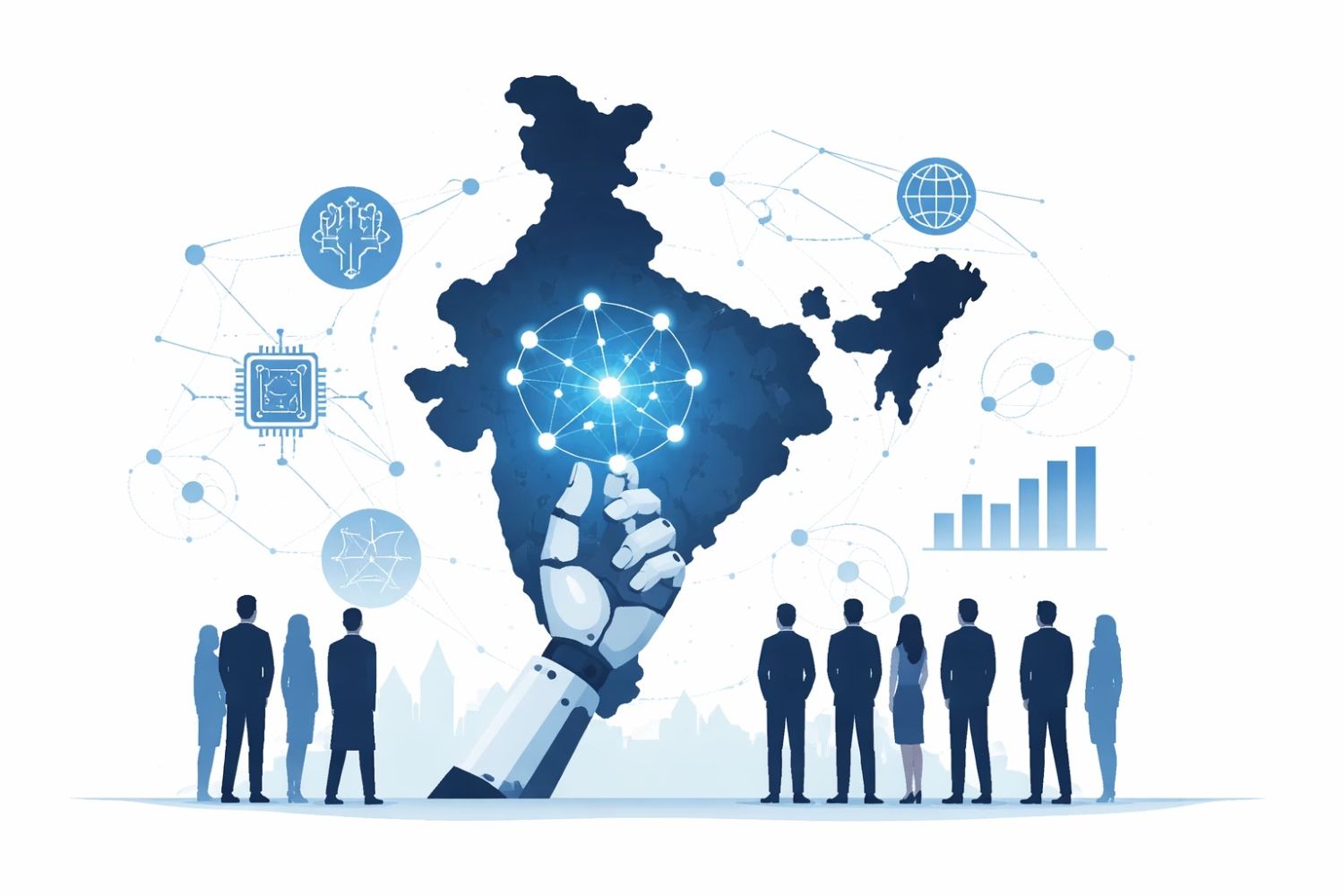
India’s push to become a global leader in artificial intelligence has drawn strong international attention following the recently held India AI Impact Summit. Governments, global tech companies and policy experts have responded to India’s plans with interest, caution and optimism.
The summit comes at a time when artificial intelligence is reshaping economies, defence systems, healthcare, finance and education worldwide. For India, which is already one of the largest digital markets, the focus is now on turning AI into a growth engine while ensuring safety and inclusion.
As global competition in AI intensifies between major powers such as the United States and China, India’s emerging role is being closely watched.
Why the India AI Impact Summit Matters
The India AI Impact Summit highlighted India’s broader digital ambitions under initiatives such as the national AI mission and the government’s focus on responsible innovation. India has already built strong digital public infrastructure through platforms like Aadhaar, UPI and large-scale digital service delivery systems. AI is being positioned as the next step in this digital journey.
The summit focused on three core themes: innovation, regulation and global cooperation. Leaders discussed how India can develop AI models suited to its linguistic diversity, large population and development needs.
India’s emphasis on “AI for all” — meaning inclusive and affordable AI solutions — has shaped global discussions around equitable access to advanced technology.
Global Policy Circles Take Note
Across policy circles in Europe and North America, India’s balanced approach to AI governance has been seen as significant. The European Union recently implemented its AI Act, one of the world’s first comprehensive AI regulations. At the same time, the United States has issued executive-level guidelines to encourage innovation while setting guardrails.
India’s approach, which aims to promote innovation while building regulatory safeguards, is being seen as a middle path between strict regulation and a light-touch model.
International observers note that India’s large developer base and strong IT services industry give it a unique position. With millions of engineers and one of the world’s largest startup ecosystems, India has the scale to influence global AI standards.
Tech Giants Respond to India’s AI Push
Global technology companies including Google, Microsoft, NVIDIA and OpenAI have expanded their presence in India over the past few years.
Several global firms have announced partnerships with Indian startups, research institutions and government-backed innovation hubs. India’s large user base makes it an important testing ground for AI applications in languages, agriculture, health diagnostics and financial inclusion.
Executives from global tech companies have repeatedly described India as one of their fastest-growing markets for AI adoption. India’s strong IT services sector also plays a role in deploying AI tools across global enterprises.
Industry analysts say that India’s ability to combine talent, scale and public digital infrastructure gives it a strong foundation to compete globally.
Strategic Importance in a Divided AI World
The global AI landscape is increasingly shaped by geopolitical tensions. The United States and China are investing billions of dollars in AI research, advanced chips and defence applications. Export controls on semiconductor technology have further complicated global supply chains.
In this environment, India is seen as a strategic partner by many Western countries. India is also a member of forums such as the Quad and G20, where digital cooperation and AI governance are key themes.
During India’s G20 presidency, digital public infrastructure and responsible AI were highlighted as important areas of collaboration. That focus has continued in international forums.
Global security experts note that India’s democratic framework gives it credibility in discussions around ethical AI and transparency.
Focus on Responsible and Inclusive AI
One of the strongest themes from the India AI Impact Summit was responsible AI. Discussions covered data privacy, algorithmic bias, cybersecurity risks and workforce transition.
India has already enacted the Digital Personal Data Protection Act. This provides a legal foundation for handling user data in AI systems.
International observers say India’s regulatory approach will influence how emerging markets think about AI governance. Many developing countries are looking for models that balance growth with safety. India’s experience may serve as a reference point.
There is also strong focus on language inclusion. With hundreds of languages spoken across the country, India is pushing for AI tools that support regional languages. This has global relevance, especially for countries with multilingual populations.
Global Investors Watch India’s AI Growth
Foreign investors are closely tracking India’s AI ecosystem. Venture capital funding in Indian AI startups has grown steadily in recent years, especially in sectors such as fintech, healthtech and agritech.
International investment firms view India as a long-term AI growth story due to its demographic advantage. With a young workforce and rising internet penetration, India offers a large market for AI-powered services.
Global semiconductor firms are also exploring partnerships in India as the country expands its chip manufacturing and design capabilities. This is seen as part of a broader strategy to diversify global supply chains.
Opportunities and Challenges Ahead
While global reactions have been largely positive, experts also point to challenges. India still needs large-scale investments in computing infrastructure, advanced chip access and high-performance data centres.
AI development requires significant energy and hardware resources. Global supply chain constraints remain a factor.
There are also concerns about workforce displacement. As AI tools automate tasks, policymakers will need to ensure skill development and reskilling programs. India’s large population means even small changes can affect millions of workers.
Education reform and technical training are expected to play a key role in India’s AI future.
India’s Role in Shaping Global AI Standards
India’s influence is likely to grow as global debates around AI governance intensify. With its large market and developer base, India can shape how AI tools are built for emerging economies.
Experts believe India’s emphasis on open digital infrastructure may encourage collaborative AI development models. Rather than focusing only on proprietary systems, India is promoting public digital goods and shared platforms.
This approach has already gained global attention in areas like digital payments and identity systems. Similar thinking may extend to AI platforms.
Global think tanks have noted that India’s leadership could help bridge gaps between developed and developing countries in AI policy discussions.
What This Means for Indian Citizens
For Indian readers, the global reaction matters because AI will increasingly shape daily life. From banking and healthcare to education and agriculture, AI-driven services are expanding.
If India succeeds in becoming a global AI hub, it could create new jobs, boost exports and strengthen the country’s digital economy.
At the same time, citizens will expect safeguards around privacy and fairness. Public trust will be critical for large-scale AI adoption.
The Road Ahead
The India AI Impact Summit has positioned India firmly in global AI conversations. The world is watching how India converts policy ambition into real outcomes.
Over the next few years, progress will depend on infrastructure investment, global collaboration and clear regulation. International partnerships with technology leaders and research institutions will also shape the pace of growth.
India’s challenge is to move from being a large consumer of AI technology to becoming a creator of globally competitive AI systems.
Global reactions show that India is no longer on the sidelines of the AI race. It is increasingly seen as a key player in shaping the future of artificial intelligence.
As governments and companies worldwide refine their AI strategies in 2026 and beyond, India’s decisions will carry growing weight on the global stage.
Disclaimer: The information presented in this article is intended for general informational purposes only. While every effort is made to ensure accuracy, completeness, and timeliness, data such as prices, market figures, government notifications, weather updates, holiday announcements, and public advisories are subject to change and may vary based on location and official revisions. Readers are strongly encouraged to verify details from relevant official sources before making financial, investment, career, travel, or personal decisions. This publication does not provide financial, investment, legal, or professional advice and shall not be held liable for any losses, damages, or actions taken in reliance on the information provided.
Edited by D Rishidhar Reddy
About The Author