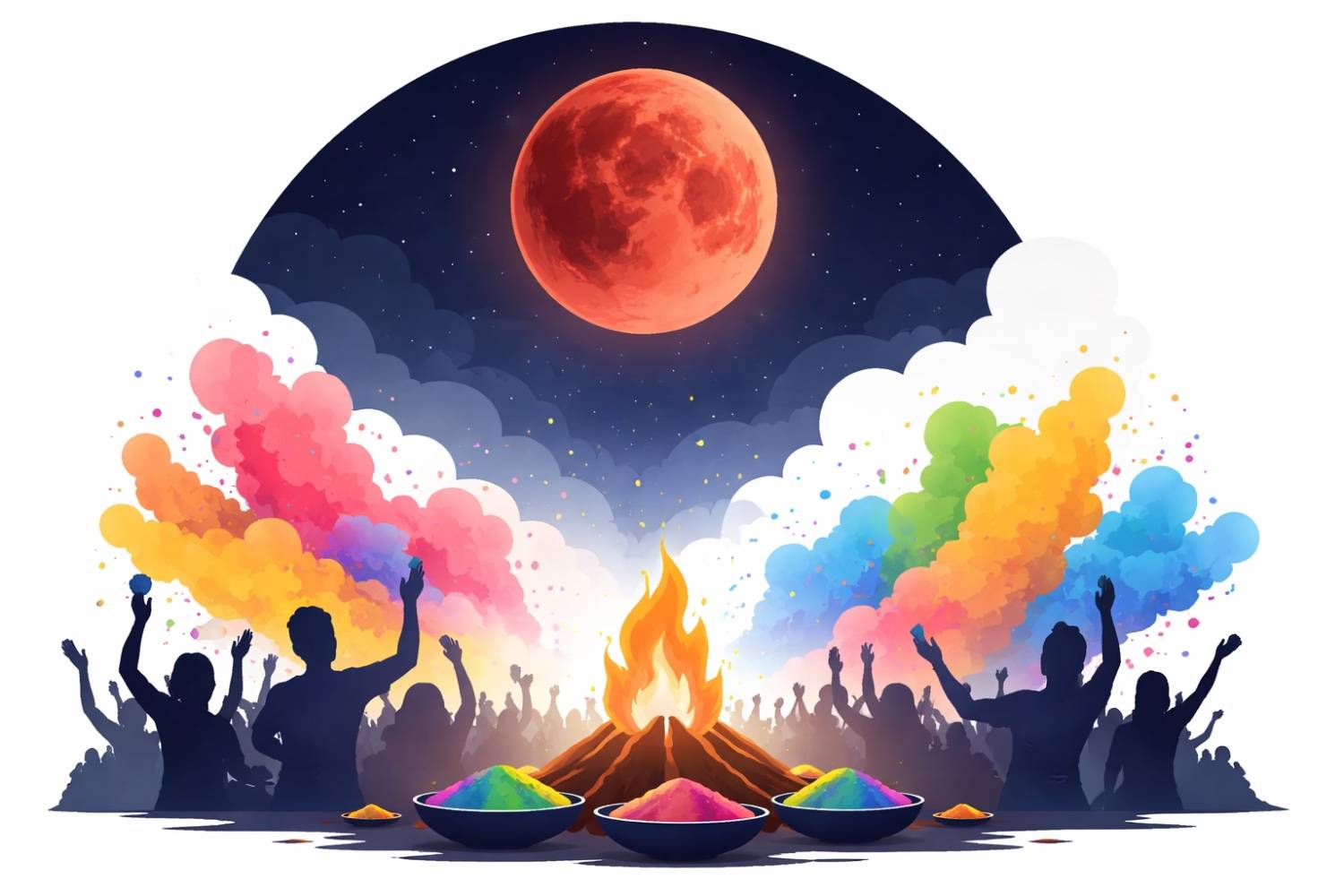
India is preparing for an unusual celestial and cultural moment as Holi 2026 coincides with a rare lunar eclipse, also known as a “blood moon” or Chandra Grahan. The rare timing of these two events has sparked widespread discussion among astronomers, religious scholars, and festival planners across the country.
Holi, the vibrant festival of colours, celebrates the arrival of spring and the victory of good over evil. A lunar eclipse, on the other hand, is a natural astronomical event when the Earth passes between the Sun and the Moon, casting a shadow on the Moon.
The overlap of these two events has added a new dimension to celebrations in many parts of India. While scientists emphasise the astronomical significance of the eclipse, religious traditions and local customs are also shaping how people observe the festival this year.
Why Holi 2026 Is Different This Year
In 2026, Holi celebrations fall close to the timing of a total lunar eclipse that will be visible in several regions across the world, including parts of Asia. This rare alignment has caught the attention of skywatchers and festival organisers alike.
The lunar eclipse occurs during a full moon, which is also the phase when Holi traditionally takes place. The festival begins with Holika Dahan, a ritual bonfire held on the night before the colour celebrations.
Because both events happen around the same time, many communities are discussing whether the eclipse may affect traditional rituals or festival schedules.
In most cities across India, however, Holi celebrations are expected to continue normally, with people focusing on cultural traditions rather than changing their plans due to the eclipse.
Understanding the “Blood Moon” Lunar Eclipse
A total lunar eclipse occurs when the Earth moves directly between the Sun and the Moon. During this alignment, the Earth’s shadow covers the Moon completely.
Instead of disappearing from the sky, the Moon often appears reddish or copper-coloured, which is why it is commonly called a blood moon.
The red colour appears because sunlight passing through Earth’s atmosphere bends and filters light, allowing red wavelengths to reach the Moon.
Astronomers note that lunar eclipses are safe to watch with the naked eye, unlike solar eclipses that require protective filters.
Skywatchers across India are expected to observe the event if weather conditions allow clear skies.
Cultural Significance of Holi Across India
Holi is one of India’s most widely celebrated festivals. From Mathura and Vrindavan in Uttar Pradesh to Jaipur, Delhi, and Mumbai, the festival brings together communities through colours, music, and traditional food.
The celebration begins with Holika Dahan, which symbolises the burning of negativity and the victory of devotion and righteousness. The next day is known as Rangwali Holi, when people play with colours, throw water balloons, and share sweets.
In many regions, Holi celebrations also include traditional folk songs and dances, community feasts, temple rituals, and cultural performances.
Tourism authorities expect millions of domestic and international visitors to travel to popular Holi destinations this year.
Cities like Varanasi, Mathura, Vrindavan, and Udaipur are already seeing increased hotel bookings as travellers prepare to experience the festival in historic settings.
How Religious Traditions View Lunar Eclipses
In Hindu tradition, lunar eclipses are sometimes considered a period when certain religious practices pause temporarily. Some households avoid eating during the eclipse and resume activities after it ends.
However, interpretations vary widely across regions and communities.
Religious scholars emphasise that Holi itself remains a major cultural celebration, and the presence of an eclipse does not cancel the festival.
Many temples and cultural groups have confirmed that Holika Dahan rituals will continue as scheduled, following the traditional calendar.
In several cities, priests have advised devotees to follow local temple guidance regarding ritual timing.
Festivals and Astronomy: A Rare Combination
The coincidence of Holi and a lunar eclipse has also sparked interest among astronomy groups and science organisations.
Observatories, science centres, and amateur astronomy clubs are planning public viewing sessions to help people understand the eclipse.
Educational institutions are using the opportunity to explain how eclipses work and to encourage interest in space science.
Experts say such events provide a valuable chance to connect science with cultural traditions.
Events like this help people understand how many traditional festivals were historically linked to lunar cycles and seasonal changes.
The Moon has long played a central role in determining dates for many Indian festivals, including Holi, Diwali, and Guru Purnima.
Impact on Holi Celebrations and Travel
Despite the unusual timing, major Holi celebrations across India are expected to proceed normally.
Hotels and travel agencies report strong bookings for Holi events in cities known for large-scale celebrations.
Tourism boards in states such as Uttar Pradesh, Rajasthan, and Goa are promoting cultural events, music festivals, and community celebrations during the Holi weekend.
Temple celebrations in Mathura and Vrindavan, royal Holi events in Udaipur palaces, and street festivals and concerts in Delhi and Mumbai are expected to draw large crowds.
Travel companies say many visitors are also excited about the chance to see a lunar eclipse on the same night as a major festival.
Safety and Scientific Viewing Advice
Astronomers stress that lunar eclipses are completely safe to watch without special equipment.
Unlike solar eclipses, no protective glasses are required.
For the best viewing experience, experts recommend watching from areas with clear skies and minimal light pollution, using binoculars or small telescopes for a closer look, and checking the exact timing of the eclipse in local regions.
Weather conditions will play a major role in visibility.
Several science centres across India are planning public observation events to help people view the eclipse safely.
The Role of Lunar Cycles in Indian Festivals
India’s traditional calendar is based on lunar and solar cycles, which means many festivals occur during specific moon phases.
Holi is celebrated on the full moon of the Hindu month of Phalguna, marking the end of winter and the beginning of spring.
Because lunar eclipses also occur only during full moons, it is possible—though relatively uncommon—for an eclipse to coincide with major festivals.
Historians say such alignments have often sparked curiosity and debate throughout history.
Ancient texts frequently mention celestial events, showing how closely astronomy and culture were linked in early Indian traditions.
Why the 2026 Event Is Drawing National Attention
The combination of a vibrant national festival and a visible lunar eclipse has made Holi 2026 a trending topic across India.
Social media platforms, science forums, and travel websites have all seen increased searches related to Holi 2026 celebrations, Chandra Grahan timing, and blood moon visibility in India.
Astronomy groups say the event could inspire more people to look up at the night sky and learn about celestial events.
For many families, the rare alignment will simply add another memorable moment to an already joyful festival.
A Festival of Colour Under a Changing Sky
As Holi celebrations begin across India, millions of people will gather with friends and family to celebrate colour, music, and community.
At the same time, the lunar eclipse will remind observers of the powerful cosmic cycles that have shaped calendars and traditions for centuries.
Whether viewed as a scientific event or a cultural curiosity, the rare overlap of Holi and a blood moon in 2026 offers a unique moment where celebration and astronomy meet.
For festival-goers and skywatchers alike, the evening promises both vibrant colours on the ground and a dramatic transformation in the night sky above.
Disclaimer: The information presented in this article is intended for general informational purposes only. While every effort is made to ensure accuracy, completeness, and timeliness, data such as prices, market figures, government notifications, weather updates, holiday announcements, and public advisories are subject to change and may vary based on location and official revisions. Readers are strongly encouraged to verify details from relevant official sources before making financial, investment, career, travel, or personal decisions. This publication does not provide financial, investment, legal, or professional advice and shall not be held liable for any losses, damages, or actions taken in reliance on the information provided.
edited by D Rishidhar
About The Author