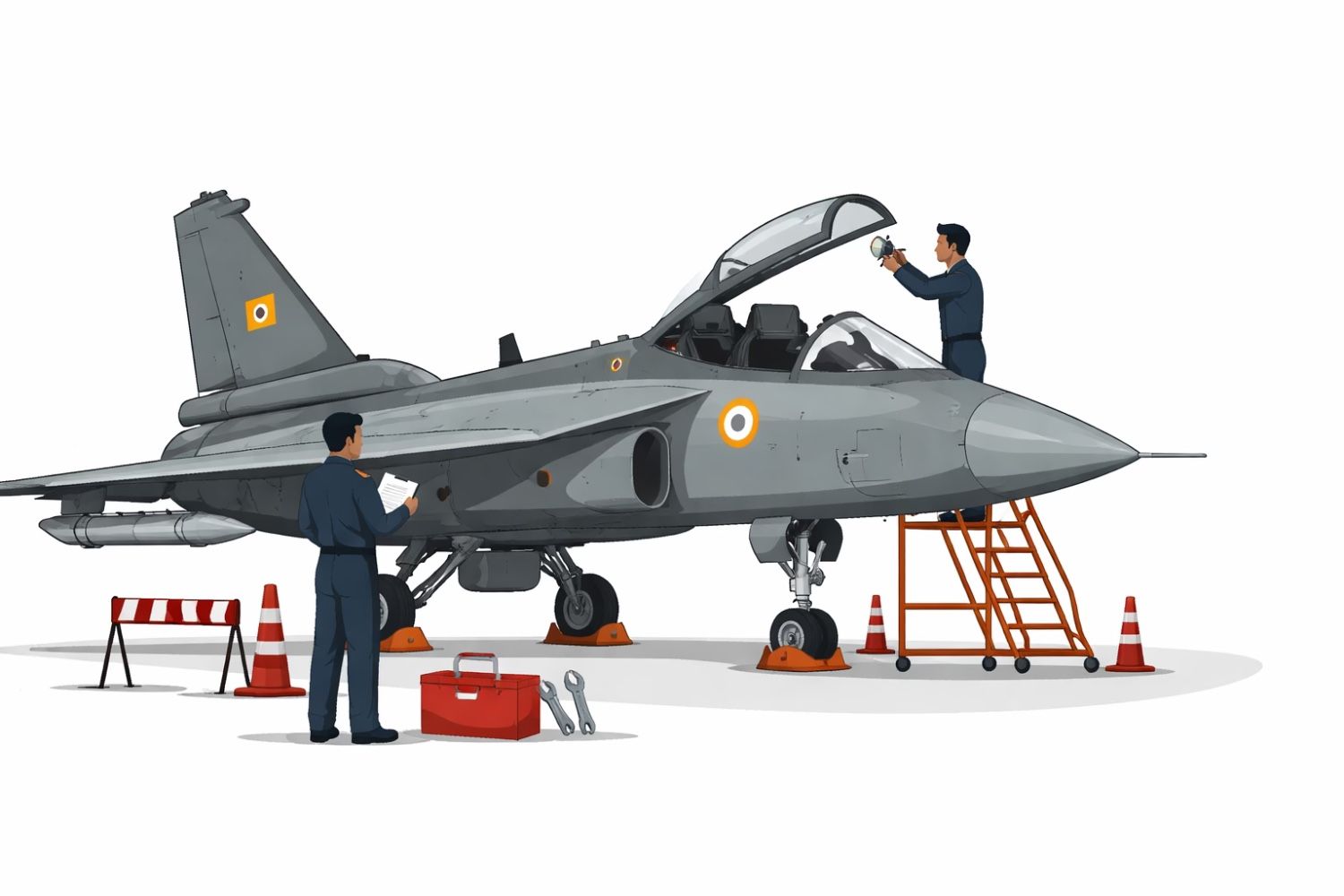
The Indian Air Force (IAF) has ordered extensive safety checks across its fleet of Tejas light combat aircraft after a recent ground incident involving one of the jets. The move comes as a precautionary step and highlights the IAF’s strict safety protocols in handling frontline fighter aircraft.
The development is significant because the Tejas, developed by the Aeronautical Development Agency (ADA) and manufactured by Hindustan Aeronautics Limited, is a key pillar of India’s indigenous defence programme. Any temporary restrictions or inspections can have an impact on operational planning and squadron availability.
Here is a detailed look at what happened, why the checks were ordered, and what it means for India’s air power strategy.
What Happened: Ground Incident Triggers Fleet-Wide Checks
According to defence sources, the incident occurred during routine ground operations. It did not involve mid-air failure or combat activity. However, as per established procedures, the IAF decided to conduct detailed inspections across the Tejas fleet to rule out any systemic issue.
The aircraft involved was part of the operational Tejas units deployed with frontline squadrons. While no major injuries were reported, the IAF has treated the event seriously and launched a standard technical evaluation.
Fleet-wide safety reviews are not unusual in military aviation. Whenever a technical snag or abnormal event occurs, air forces globally carry out precautionary inspections to ensure safety and mission readiness.
About Tejas: India’s Indigenous Fighter Jet
The Tejas Light Combat Aircraft (LCA) is India’s homegrown fighter jet programme. It was designed by the Aeronautical Development Agency (ADA) and manufactured by Hindustan Aeronautics Limited.
The aircraft is meant to replace the ageing MiG-21 fleet and strengthen India’s combat capabilities with modern systems.
The IAF currently operates multiple Tejas squadrons, including No. 45 Squadron “Flying Daggers” and No. 18 Squadron “Flying Bullets”.
In February 2021, the Government of India signed a major contract worth around ₹48,000 crore for 83 Tejas Mk1A aircraft. The Mk1A variant features advanced avionics, improved radar systems, electronic warfare capabilities, and better maintainability.
The aircraft is central to India’s push for self-reliance in defence production.
Why the IAF Ordered Extensive Safety Checks
The IAF follows strict safety protocols governed by its Directorate of Flight Safety. After any technical irregularity, the force usually orders detailed engineering inspections, review of maintenance records, and checks of critical systems.
Such reviews help identify whether the issue is isolated or part of a broader technical concern.
Precautionary checks do not automatically mean a design flaw. Many times, incidents are linked to maintenance factors or minor component issues rather than structural problems.
The IAF has not indicated a long-term grounding of the fleet. The focus remains on ensuring that all aircraft meet safety standards before continuing normal sortie rates.
Impact on Squadron Readiness
India currently operates around 30–32 active fighter squadrons, while the sanctioned strength is 42 squadrons. The Tejas induction is important to bridge this gap.
If safety inspections temporarily reduce Tejas flying hours, it could affect short-term operational tempo. However, the IAF maintains a diversified fleet that includes the Su-30MKI, Rafale, Mirage 2000, and Jaguar aircraft.
These platforms ensure that India’s air defence posture remains stable even if one fleet undergoes technical review.
Military planning includes redundancy. Even when a platform is under inspection, others continue operations without affecting national security.
HAL’s Role and Ongoing Production
Hindustan Aeronautics Limited has been ramping up production capacity for the Tejas Mk1A. Additional assembly lines in Bengaluru are aimed at meeting delivery timelines agreed with the IAF.
The ground incident and safety checks are unlikely to halt production unless a major technical issue is identified. In most cases, manufacturing continues while investigations proceed.
Coordination between HAL and the IAF remains essential during technical reviews to ensure swift resolution of any findings.
Strategic Importance of Tejas in India’s Defence Planning
The Tejas programme represents India’s effort to reduce dependence on foreign suppliers and build domestic aerospace capability.
It supports indigenous design, local supply chains, and long-term technology development. The aircraft has also been offered for export to friendly nations, reflecting India’s growing ambition in defence exports.
Handling safety concerns swiftly and transparently is important to maintain confidence among domestic stakeholders and potential export partners.
Past Safety Record of Tejas
The Tejas achieved Final Operational Clearance status in 2019. While the programme faced development delays in earlier years, it has not been associated with a high accident rate compared to older aircraft fleets.
Military aviation always carries risks. What matters is the speed of investigation and corrective action. The IAF’s current approach appears precautionary and procedure-driven.
What Happens Next
The next steps are likely to include technical inspection reports and evaluation by flight safety teams. Based on findings, the IAF may clear the fleet for normal operations or issue technical advisories if required.
If the issue is minor and isolated, disruption will be limited. If a broader technical concern is detected, corrective measures may be implemented before full operational clearance.
Impact on India’s Air Power Outlook
In the larger picture, this development does not significantly weaken India’s air power.
The Tejas forms one part of India’s combat inventory. The IAF continues to induct new aircraft and upgrade existing fleets while advancing programmes such as Tejas Mk2 and the Advanced Medium Combat Aircraft.
India’s long-term modernisation roadmap remains intact.
However, the episode highlights the importance of strong quality control as India expands indigenous defence production. Maintaining high safety standards strengthens trust among pilots, planners, and international partners.
Why This News Matters Now
India is expanding its indigenous defence ecosystem. With rising regional security concerns and ongoing modernisation, fleet readiness is critical.
A precautionary safety review reflects professionalism and a safety-first approach. It shows that pilot welfare and aircraft reliability remain top priorities.
For Indian readers, the key message is clear: the Tejas remains central to India’s defence strategy, and the current safety checks are part of standard military aviation procedures.
Conclusion
The IAF’s decision to order extensive safety checks after the Tejas ground incident demonstrates a proactive approach to aviation safety.
There is no indication of widespread grounding or long-term operational impact at this stage. The aircraft continues to be a cornerstone of India’s indigenous fighter programme.
As investigations continue, coordination between the IAF and HAL will be crucial. For now, India’s overall air power posture remains stable, and modernisation plans continue as scheduled.
Disclaimer: The information presented in this article is intended for general informational purposes only. While every effort is made to ensure accuracy, completeness, and timeliness, data such as prices, market figures, government notifications, weather updates, holiday announcements, and public advisories are subject to change and may vary based on location and official revisions. Readers are strongly encouraged to verify details from relevant official sources before making financial, investment, career, travel, or personal decisions. This publication does not provide financial, investment, legal, or professional advice and shall not be held liable for any losses, damages, or actions taken in reliance on the information provided.
About The Author