
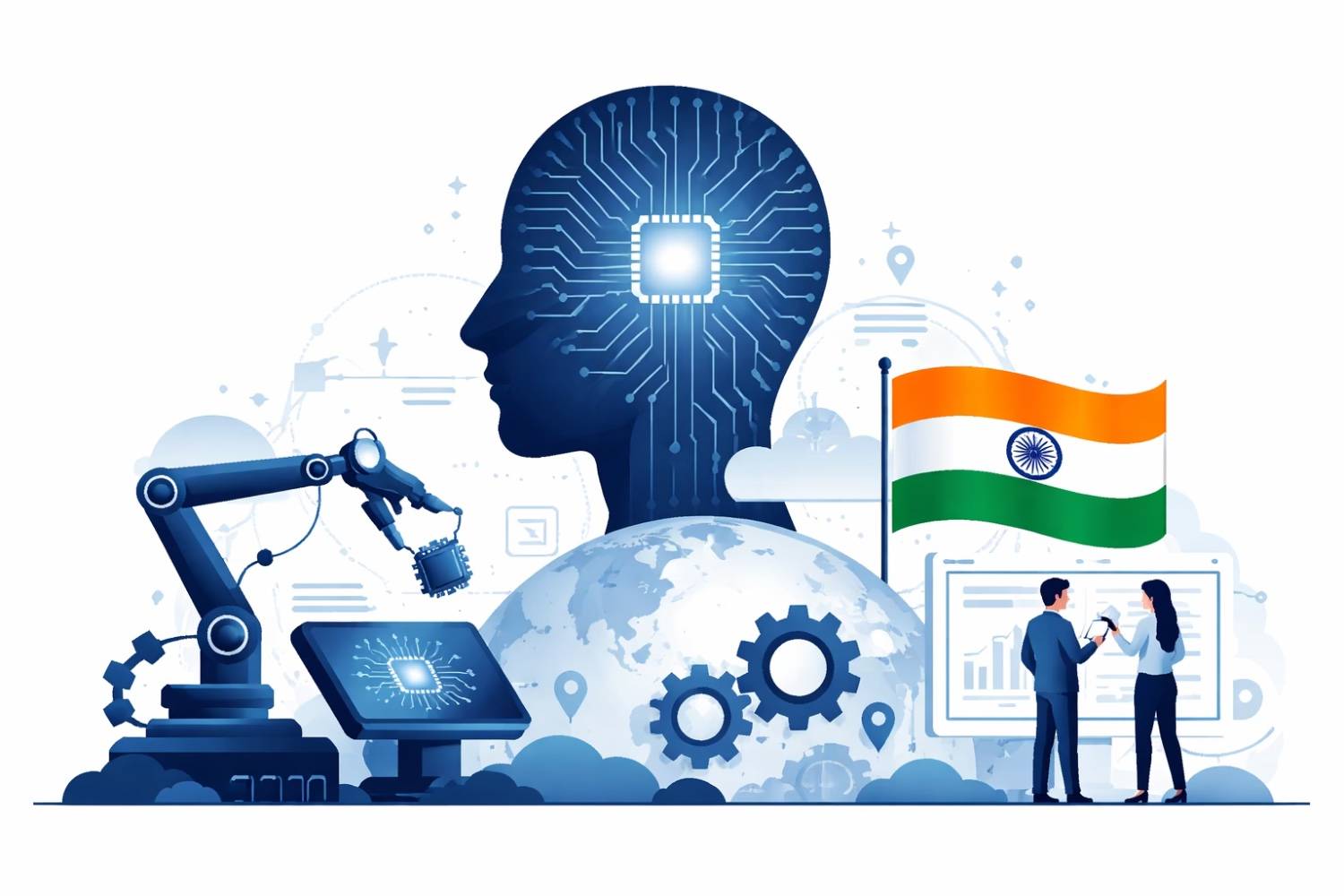
India’s fast-growing artificial intelligence ecosystem took center stage at the India AI Impact Summit 2026, where policymakers, industry leaders, researchers and startup founders came together to discuss the next phase of the country’s digital transformation. The summit comes at a time when artificial intelligence is no longer a future concept but a present-day driver of economic growth, public services and private innovation.
With the Government of India pushing forward the IndiaAI Mission and increased focus on digital public infrastructure, the summit discussions offered a clear view of how AI will shape India’s economy in the coming years. From compute infrastructure and responsible AI to startups and job creation, the event highlighted both opportunities and challenges.
Why the India AI Impact Summit 2026 Matters
Artificial intelligence has become central to India’s technology roadmap. The government has repeatedly stated that AI will play a key role in improving governance, healthcare, agriculture, education and manufacturing.
The summit took place amid growing global competition in AI development. Countries are investing heavily in AI research, chip manufacturing and data infrastructure. For India, the focus is on building affordable, scalable and inclusive AI solutions that can serve over 1.4 billion people.
India already has one of the world’s largest developer communities and a strong IT services industry. The question now is how the country can move from being a technology services provider to becoming a global AI innovation hub.
IndiaAI Mission and Public Digital Infrastructure
A major theme at the summit was the IndiaAI Mission, which aims to build a strong AI ecosystem in the country. The mission focuses on several pillars including compute infrastructure, datasets, skilling and startups.
Speakers stressed the importance of sovereign AI infrastructure. Access to high-performance computing is critical for training advanced AI models. Discussions centered on expanding domestic AI compute capacity so Indian researchers and startups do not depend entirely on foreign platforms.
India’s existing digital public infrastructure such as Aadhaar, UPI and DigiLocker was also highlighted as a foundation for AI-led innovation. These platforms have already transformed payments and identity verification. Experts at the summit said similar digital building blocks could support AI applications in public services.
Focus on Responsible and Ethical AI
Another key takeaway from the summit was the emphasis on responsible AI. Policymakers and industry leaders agreed that AI systems must be safe, transparent and accountable.
India has been working on AI governance frameworks to balance innovation with regulation. The discussions reflected a cautious but growth-oriented approach. Instead of over-regulation, the focus is on risk-based frameworks and sector-specific guidelines.
Data privacy and cybersecurity were central to the conversation. With AI models relying heavily on large datasets, ensuring data protection is essential. The summit underlined the need for strong safeguards to prevent misuse of AI systems.
AI for Bharat: Local Language and Inclusion
India’s diversity makes AI development unique. The summit repeatedly stressed the need for AI systems that support Indian languages and regional contexts.
Experts noted that for AI to truly benefit the country, it must serve users beyond major cities. Local language AI tools can support farmers, small businesses and students in rural areas.
Voice-based AI applications were discussed as a powerful way to increase digital inclusion. With millions of new internet users coming online through mobile devices, speech-driven AI solutions can reduce barriers created by literacy and language.
Startups and Investment Momentum
The India AI Impact Summit 2026 also showcased the strength of India’s startup ecosystem. AI-focused startups are growing across sectors such as fintech, healthtech, edtech, agritech and logistics.
Venture capital activity in AI has increased over the past few years, reflecting investor confidence. Founders at the summit highlighted how generative AI and machine learning tools are helping businesses automate operations, improve customer service and enhance data analysis.
However, startup founders also pointed to challenges. Access to affordable computing resources, high-quality datasets and skilled talent remains a concern. The summit discussions suggested that public-private partnerships will be crucial to address these gaps.
AI and Job Market Transformation
One of the most closely watched topics at the summit was the impact of AI on jobs. India’s IT services industry employs millions of professionals. As automation tools become more advanced, companies are restructuring workflows.
Industry leaders acknowledged that some repetitive tasks may reduce over time. However, they also emphasized that AI will create new roles in data science, AI model training, cybersecurity and AI governance.
Reskilling emerged as a major priority. Educational institutions and corporate training programs are expected to play a key role in preparing the workforce for AI-driven roles. The summit highlighted the need to align curricula with emerging technologies.
Global Partnerships and India’s Strategic Position
India’s position in the global AI race was another important discussion point. With geopolitical shifts and supply chain realignments, technology partnerships are evolving.
India is seen as a trusted technology partner for many countries. Its democratic framework, large talent pool and cost advantages make it an attractive AI development destination.
Speakers at the summit stressed the importance of international collaboration in areas such as AI research, semiconductor manufacturing and cloud infrastructure. At the same time, building domestic capability remains a strategic priority.
AI in Key Sectors: Healthcare, Agriculture and Governance
The summit highlighted practical use cases where AI is already making a difference.
In healthcare, AI tools are being used for diagnostics, predictive analytics and hospital management systems. In agriculture, AI-powered advisory systems help farmers with crop monitoring and weather insights.
In governance, AI can support data-driven decision-making and service delivery. Officials discussed the role of AI in improving efficiency and reducing delays in public services.
These sector-specific applications show that AI is not limited to tech companies. It has direct implications for everyday life.
Challenges That Still Need Attention
While optimism was high, the summit also acknowledged several challenges.
High-performance computing remains expensive. Semiconductor supply chains are complex and largely controlled by a few countries. India will need sustained investment to build its own hardware ecosystem.
There are also concerns around misinformation and deepfake content powered by AI. Policymakers stressed the need for public awareness and strong enforcement mechanisms.
Another challenge is bridging the urban-rural digital divide. Without strong connectivity and digital literacy, AI adoption may remain limited in certain regions.
What’s Next for Indian Tech After the Summit
The India AI Impact Summit 2026 made it clear that AI will remain central to India’s economic strategy.
In the coming months, stakeholders will closely watch how policy announcements translate into action. Implementation of AI infrastructure projects, funding support for startups and rollout of skilling programs will be key indicators.
Technology companies are expected to increase AI integration across products and services. Enterprises will likely invest more in automation and data-driven decision-making.
For consumers, AI-powered applications in finance, healthcare and education may become more common. For businesses, AI adoption may shift from experimentation to full-scale deployment.
India’s AI Moment
The summit underscored that India stands at an important moment in its digital journey. The country has scale, talent and a strong digital foundation. The challenge now is execution.
If India can combine responsible regulation, strong infrastructure and inclusive innovation, it has the potential to become a global AI leader.
The India AI Impact Summit 2026 did not promise overnight transformation. Instead, it offered a realistic roadmap. The focus is clear: build capacity, support startups, protect users and ensure AI benefits every section of society.
As global competition intensifies, India’s approach will be tested. But the message from the summit was consistent. AI is no longer optional. It is central to the future of Indian technology and economic growth.
For readers tracking India AI news, tech policy updates and startup trends, the developments from this summit signal that the country’s AI story is entering a decisive phase.
Disclaimer: The information presented in this article is intended for general informational purposes only. While every effort is made to ensure accuracy, completeness, and timeliness, data such as prices, market figures, government notifications, weather updates, holiday announcements, and public advisories are subject to change and may vary based on location and official revisions. Readers are strongly encouraged to verify details from relevant official sources before making financial, investment, career, travel, or personal decisions. This publication does not provide financial, investment, legal, or professional advice and shall not be held liable for any losses, damages, or actions taken in reliance on the information provided.
edited by D Rishidhar Reddy
About The Author