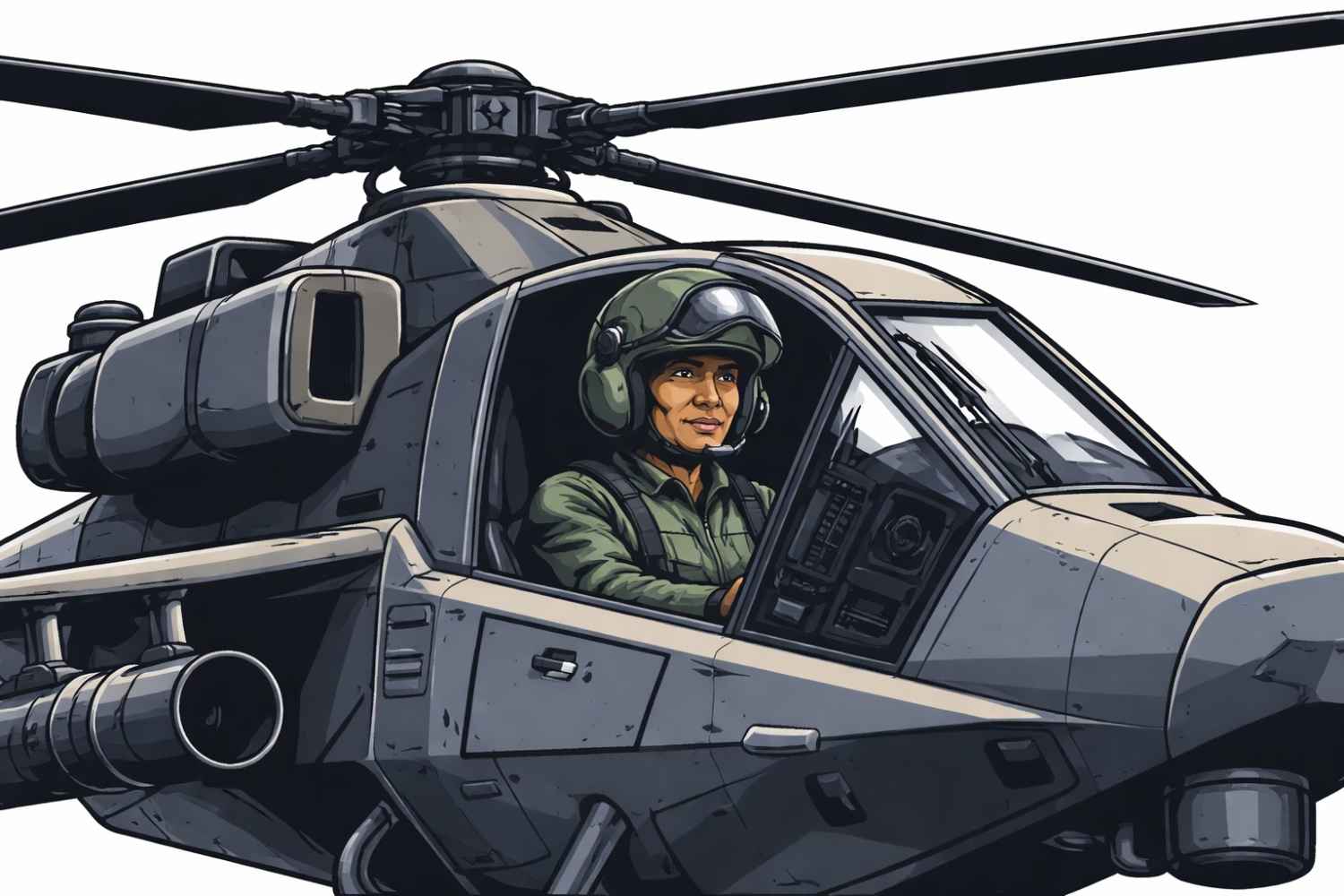
In a historic and symbolic moment for India, President Droupadi Murmu became the first Indian Head of State to fly in an indigenous Light Combat Helicopter (LCH), marking a major milestone for the country’s defence capabilities and women’s leadership in high office.
The event holds significance not only because of the aircraft involved, but also because of the message it sends about India’s growing confidence in its home-grown military technology. The helicopter flown by the President was the indigenously developed Light Combat Helicopter, designed and manufactured by Hindustan Aeronautics Limited.
The development comes at a time when India is actively promoting “Aatmanirbhar Bharat” in defence manufacturing. The President’s participation in such a symbolic activity highlights both the nation’s defence preparedness and the increasing trust in indigenous platforms.
Droupadi Murmu
Droupadi Murmu, who took office as the 15th President of India in July 2022, has often emphasized national development, women’s empowerment and indigenous progress. Her participation in flying the Light Combat Helicopter adds another first to her tenure.
As Supreme Commander of the Indian Armed Forces, the President plays a constitutional role in defence matters. However, such operational engagements are rare and symbolically powerful.
About the Indigenous Light Combat Helicopter (LCH)
Hindustan Aeronautics Limited
HAL Light Combat Helicopter
The Light Combat Helicopter, also known as LCH “Prachand,” is India’s first indigenously designed and developed attack helicopter.
Developed by Hindustan Aeronautics Limited, the helicopter is built to operate in extreme conditions, including high-altitude regions such as the Himalayas. It is designed for combat roles like air-to-ground attacks, air defence, anti-tank operations and close air support.
The LCH was formally inducted into the Indian Air Force in October 2022. Its induction marked a major step in reducing dependence on imported attack helicopters.
Key highlights of the LCH include its ability to operate at altitudes above 16,000 feet, support modern avionics and weapons systems, and perform effectively in both desert and high-altitude warfare conditions.
India has placed orders for multiple units of the helicopter for both the Indian Air Force and the Indian Army, strengthening frontline capabilities.
Why This Flight Matters Today
The President’s flight in the indigenous attack helicopter is more than a ceremonial moment. It sends three strong signals.
First, it reflects confidence in India’s domestic defence manufacturing sector. The LCH represents years of research, testing and indigenous engineering.
Second, it highlights the increasing visibility of women in leadership roles connected to defence and security. Droupadi Murmu already made history as India’s first tribal President and the second woman to hold the office. This event adds another milestone to that journey.
Third, it strengthens public awareness about India’s push toward defence self-reliance. In recent years, the government has expanded the defence production budget, increased export targets and restricted imports of certain military equipment to boost domestic manufacturing.
India’s Growing Focus on Defence Self-Reliance
Under the “Aatmanirbhar Bharat” initiative, India has been working to increase indigenous defence production.
The country has introduced negative import lists, encouraging the armed forces to procure equipment domestically whenever possible. Indigenous platforms like the LCH and the Light Combat Aircraft Tejas have become central to this strategy.
The President’s flight serves as a visible endorsement of these efforts.
India has also been increasing defence exports in recent years, supplying equipment to friendly nations. Indigenous helicopters and aircraft platforms are expected to play a larger role in this export push.
Role of the President as Supreme Commander
As the constitutional head of the Indian Armed Forces, the President holds the title of Supreme Commander. While operational decisions are taken by the government and military leadership, the President’s role carries symbolic weight.
Over the years, Presidents have visited forward bases, interacted with troops and participated in ceremonial military activities. However, flying in an indigenous combat helicopter adds a new dimension to this engagement.
Such gestures are seen as morale boosters for the armed forces and defence scientists who have worked on complex indigenous projects.
Boost to Women in Uniform and Defence Roles
The moment also resonates strongly with women serving in the armed forces.
In recent years, India has expanded opportunities for women in combat and command roles. Women officers are now being inducted into permanent commissions across various branches of the armed forces.
The President’s participation in flying an attack helicopter reinforces the message that leadership and defence responsibilities are not limited by gender.
It also aligns with broader national conversations around women’s representation in leadership, technology and strategic sectors.
Public and Strategic Impact
From a public perspective, the visuals of the President inside the cockpit of an indigenous attack helicopter are powerful.
They highlight India’s technological advancement and strategic readiness. At a time when global security tensions remain high in different parts of the world, visible demonstrations of defence capability carry diplomatic and domestic importance.
Strategically, the LCH strengthens India’s ability to operate in challenging terrains, especially high-altitude border areas. Its deployment enhances flexibility and quick response in sensitive regions.
Induction and Operational Significance
The Light Combat Helicopter was inducted into the Indian Air Force in October 2022 in Jodhpur. The helicopter has since been deployed in various operational roles.
The Army has also begun inducting its own units of the LCH, tailored to ground support and tactical operations.
Its high-altitude capability is particularly important for India, given the terrain along its northern borders. Traditional attack helicopters often face performance limits at extreme altitudes. The LCH was designed with this challenge in mind.
The President’s flight underscores the operational readiness and trust placed in the platform.
A Symbol of Confidence in Indigenous Technology
India’s defence sector has long relied on imports for advanced platforms. However, the past decade has seen a clear policy shift toward domestic production.
The LCH stands as a flagship example of this transformation.
By choosing to fly in an indigenous attack helicopter, the President sends a clear message of institutional support for Indian engineering and manufacturing.
This moment is likely to be remembered as part of the broader story of India’s defence modernisation.
What This Means for the Future
The historic flight could inspire greater public interest in defence innovation and aerospace engineering.
India is investing heavily in research and development across aviation, missile systems and advanced technologies. Indigenous platforms are expected to play a larger role in the coming years.
As defence budgets evolve and technology becomes more central to national security, symbolic milestones such as this gain long-term importance.
President Droupadi Murmu’s participation in flying the indigenous Light Combat Helicopter combines constitutional symbolism with strategic messaging. It highlights India’s growing confidence in its own defence manufacturing ecosystem and reinforces the country’s push toward self-reliance.
For Indian readers, the moment represents both national pride and a visible sign of progress in aerospace capability. As India continues to modernise its armed forces, such milestones reflect a changing and more self-assured defence landscape.
Disclaimer: The information presented in this article is intended for general informational purposes only. While every effort is made to ensure accuracy, completeness, and timeliness, data such as prices, market figures, government notifications, weather updates, holiday announcements, and public advisories are subject to change and may vary based on location and official revisions. Readers are strongly encouraged to verify details from relevant official sources before making financial, investment, career, travel, or personal decisions. This publication does not provide financial, investment, legal, or professional advice and shall not be held liable for any losses, damages, or actions taken in reliance on the information provided.
edited by D Rishidharreddy
About The Author