
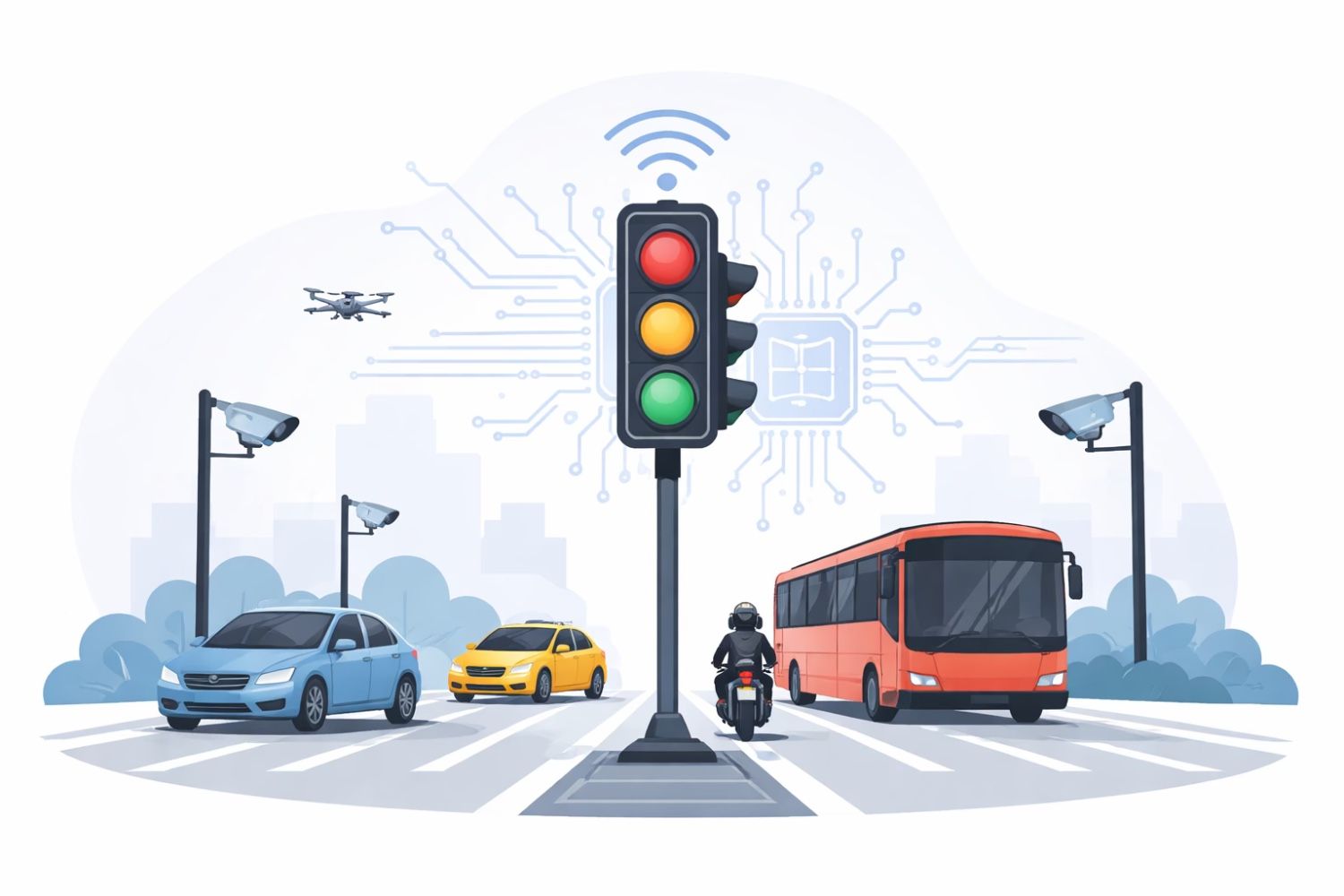
Pune has become the first Indian city to roll out a Google-powered traffic management system aimed at reducing congestion and improving signal efficiency across key junctions. The move marks a major step in the use of data-driven technology to tackle one of urban India’s biggest challenges — road traffic.
The initiative is being implemented in partnership with civic authorities and traffic police, using real-time data and artificial intelligence tools supported by Google’s traffic technology. With Pune’s growing population and rising number of vehicles, officials believe the system can improve daily commute times and make roads safer.
The development is important not just for Pune, but for other Indian cities looking for smart traffic solutions.
Why Pune’s Traffic Situation Needed Urgent Reform
Pune is one of India’s fastest-growing urban centres. Over the last decade, the city has seen rapid expansion in IT hubs, residential areas, and commercial zones.
As per official data from Maharashtra transport authorities, Pune district has over 40 lakh registered vehicles, including two-wheelers, cars, buses, and goods carriers. Peak-hour congestion has become common in areas such as Shivajinagar, Hinjawadi, Wakad, Kothrud, and Swargate.
Traffic signal timings in many parts of the city were earlier based on fixed cycles. These did not always match the real-time traffic flow. This led to long waiting times at signals, especially during office hours and weekends.
City authorities have been looking for technology-based solutions under the broader Smart City mission. The new Google-powered system is part of that effort.
How the Google-Powered Traffic Management System Works
The new system uses Google’s traffic data and artificial intelligence tools to analyse road movement patterns in real time.
Google collects anonymised location data from users who enable location services on their smartphones. This data helps understand traffic density, speed patterns, and congestion points across the city.
Using this information, the system can:
Adjust traffic signal timings dynamically based on live traffic
Predict congestion build-up before it becomes severe
Improve coordination between nearby intersections
Provide better traffic updates to commuters through navigation apps
Instead of a fixed green light duration, signals can now change depending on the number of vehicles waiting at a junction.
For example, if one side of an intersection has heavier traffic, the green light duration can be extended automatically. On lighter traffic routes, signal timing can be reduced to improve overall flow.
Officials say the aim is to reduce idle time at signals and cut down unnecessary fuel use.
Integration With Pune Traffic Police Systems
The rollout has been done in coordination with the Pune Traffic Police and municipal authorities.
Existing traffic signal infrastructure has been integrated with software that can receive and process real-time inputs. In some locations, adaptive signal controllers have been installed to allow automatic timing adjustments.
Traffic control rooms can monitor live updates and intervene manually if needed, especially during emergencies or VIP movements.
Authorities have clarified that the system uses aggregated, anonymised data. Personal user information is not shared with traffic departments.
Expected Benefits for Daily Commuters
For Pune residents, the biggest impact is expected to be shorter waiting times at signals and smoother movement during peak hours.
Adaptive traffic management systems in other global cities have shown that such technology can reduce average travel time by 10 to 20 percent, depending on traffic density and implementation quality.
While Pune officials have not announced exact projections yet, they expect measurable improvement in congestion at major intersections.
Better traffic flow may also lead to:
Lower fuel consumption
Reduced air pollution due to less idling
Improved emergency vehicle movement
More predictable travel time
For IT professionals travelling daily to Hinjawadi and Baner, or students commuting to colleges in central Pune, even small time savings can make a big difference.
How Google’s Traffic Technology Is Used Globally
Google has already been working with several global cities to improve traffic systems.
The company’s traffic data powers navigation tools used worldwide. In recent years, it has collaborated with city governments to optimise signal timings and reduce congestion using AI-based analysis.
In some international pilot projects, cities reported lower traffic delays after adjusting signal patterns based on Google’s recommendations.
Pune is the first city in India to formally implement this type of Google-supported adaptive traffic management on a city-wide scale.
This makes the project a potential model for metros like Mumbai, Bengaluru, Hyderabad, and Delhi, where traffic congestion is a daily issue.
What Makes This Different From Traditional Smart Signals
Many Indian cities have installed smart traffic lights in recent years. However, most operate using pre-programmed timing schedules or local sensor inputs.
The key difference in Pune’s case is the use of large-scale, city-wide real-time traffic data supported by Google’s AI systems.
Instead of relying only on on-ground sensors at a single junction, the system analyses movement patterns across multiple roads at once.
This wider data pool allows better prediction of traffic waves and bottlenecks.
It also helps coordinate neighbouring intersections, reducing the stop-start pattern that frustrates drivers.
Data Privacy and Safety Measures
Whenever traffic systems rely on digital data, privacy becomes a concern.
Officials involved in the Pune rollout have stated that the system uses anonymised and aggregated traffic data. Individual identities are not accessible to traffic departments.
Google’s traffic information is based on collective patterns rather than personal tracking.
This approach aligns with global data protection standards, where individual user data is not exposed to third parties.
Still, experts say continuous oversight and transparency will be important as more cities adopt such systems.
Phased Implementation Across Pune
The system is being rolled out in phases.
In the first phase, major traffic junctions and high-density corridors are being prioritised. These include areas with frequent bottlenecks and long signal waiting times.
Based on performance reviews and traffic feedback, the system may be expanded to cover more intersections across the city.
Authorities are expected to monitor metrics such as:
Average waiting time at signals
Vehicle throughput at key junctions
Peak-hour congestion duration
Public feedback
If results are positive, similar projects could be proposed for other Maharashtra cities.
Impact on Air Pollution and Urban Planning
Traffic congestion is not just about inconvenience. It has a direct link to air quality and fuel consumption.
Pune has faced periodic air quality concerns, especially during winter months.
Reducing idle engine time at signals can help lower emissions of carbon monoxide and particulate matter.
Urban planners also say that data collected through such systems can help in long-term planning.
By studying traffic patterns, authorities can identify where road widening, flyovers, or public transport improvements are needed.
The system can also support better bus route planning and emergency response strategies.
Challenges and What to Watch Next
While the technology offers promise, experts caution that success depends on proper maintenance and coordination.
Signal hardware must function correctly. Software updates must be timely. Traffic police must remain trained to use and supervise the system.
Public awareness is also important. Drivers must follow lane discipline and signal rules for adaptive systems to work efficiently.
In the coming months, commuters will closely watch whether peak-hour congestion in areas like Wakad, Aundh, and Shivajinagar actually reduces.
Independent traffic studies may help measure the true impact of the new system.
A Possible Blueprint for Urban India
With cities across India struggling with traffic jams, Pune’s Google-powered traffic management system could become a test case.
If the project delivers visible improvement, it may encourage other urban centres to adopt similar AI-driven traffic solutions.
As India moves toward smarter cities and digital governance, data-based traffic management is likely to play a bigger role.
For now, Pune has taken the first step.
And for lakhs of daily commuters, even a few minutes saved at every signal could change the way they experience the city’s roads.
Disclaimer: The information presented in this article is intended for general informational purposes only. While every effort is made to ensure accuracy, completeness, and timeliness, data such as prices, market figures, government notifications, weather updates, holiday announcements, and public advisories are subject to change and may vary based on location and official revisions. Readers are strongly encouraged to verify details from relevant official sources before making financial, investment, career, travel, or personal decisions. This publication does not provide financial, investment, legal, or professional advice and shall not be held liable for any losses, damages, or actions taken in reliance on the information provided.
About The Author