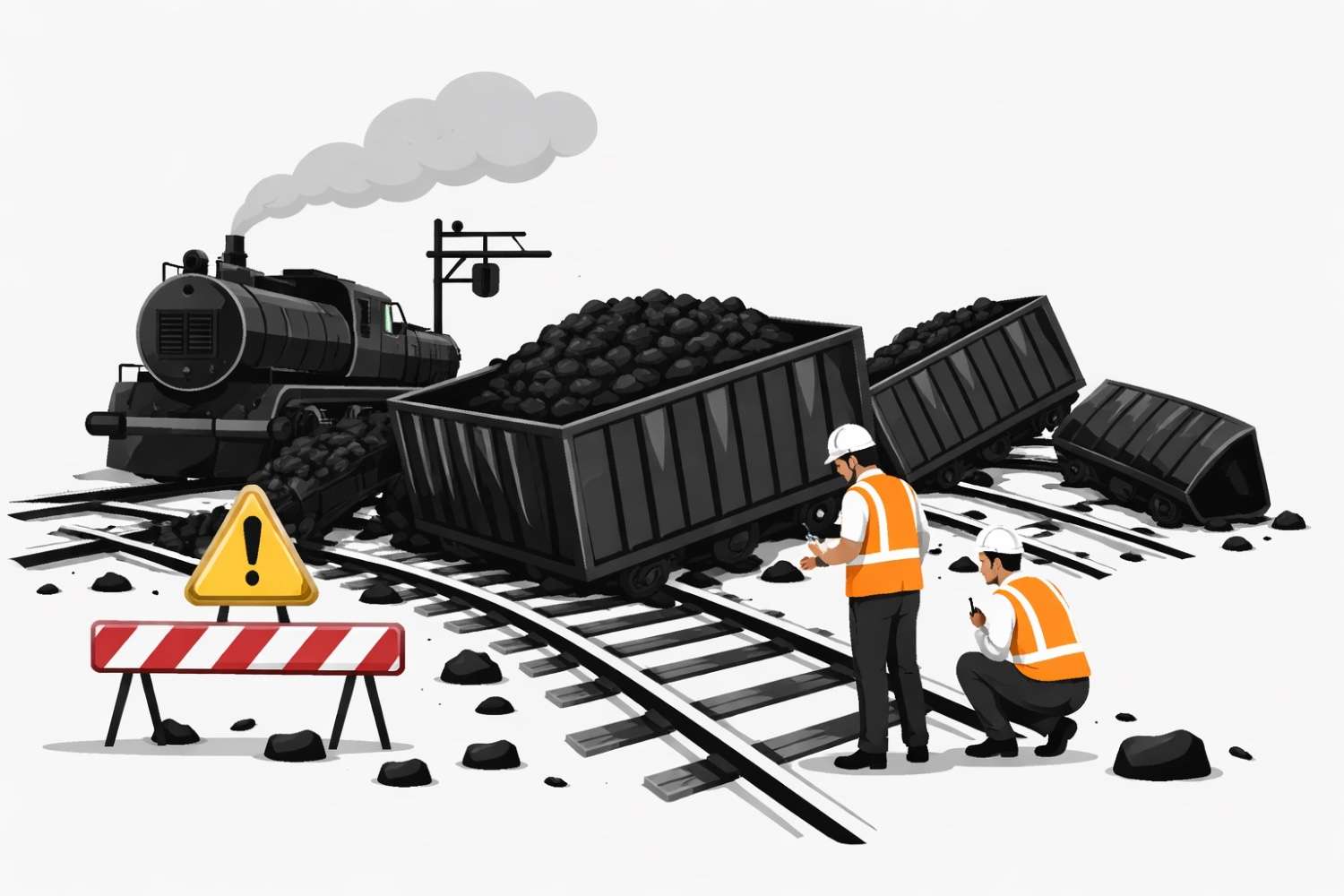
Rail traffic in parts of central India faced disruption after a coal-laden freight train derailed in Katni district of Madhya Pradesh, affecting movement on an important railway corridor.
Railway officials confirmed that several wagons of the goods train carrying coal left the tracks, forcing authorities to temporarily suspend rail operations on the affected line while restoration work began.
The derailment occurred on a route that handles heavy freight movement, especially coal supply for power plants and industries, making it a critical rail link. As emergency teams rushed to the site, railway engineers began efforts to clear the track and restore services.
Authorities have launched an investigation to determine the exact cause of the incident. Early reports indicate that no casualties have been reported, but the derailment has led to delays and operational challenges for trains passing through the section.
Where the Derailment Happened
The incident took place near Katni in Madhya Pradesh, an important railway junction that connects several key freight and passenger routes in central India.
Katni plays a major role in the transport of coal from mining regions to thermal power plants across multiple states. Because of this, freight trains carrying coal frequently pass through the area.
According to railway officials, the derailment occurred when multiple wagons of a coal freight train came off the track during transit.
The exact section of track was immediately secured by railway authorities. Local railway staff and technical teams reached the spot soon after the derailment was reported.
Emergency response teams began inspection and restoration work to remove derailed wagons and repair the damaged track infrastructure.
Immediate Impact on Rail Traffic
The derailment disrupted operations on the affected line, leading to temporary suspension of train movement in the section.
Railway authorities stated that traffic had to be halted to ensure safety while engineers inspected the track and began clearing operations.
Because Katni is an important junction, the disruption could potentially affect freight trains carrying coal and minerals, passenger trains passing through the section, and long-distance trains connecting central India.
Railway control rooms began coordinating train operations to regulate movement and manage delays.
In such situations, trains may be diverted, rescheduled, or held at nearby stations until the track becomes safe for operations again.
Officials are monitoring the situation closely to restore normal movement as quickly as possible.
Coal Supply Routes and Why This Line Matters
Coal freight trains form a major part of railway cargo movement in India. Routes through Madhya Pradesh are crucial because they link coal-producing regions with power plants across multiple states.
The rail corridor through Katni supports movement of coal from mines in nearby regions toward power generation facilities, industrial plants, and steel and cement industries.
Any disruption in coal freight movement can affect logistics schedules and supply chains, especially when large freight volumes depend on a single rail corridor.
However, railway authorities typically have backup operational plans, including alternate routing of freight trains if needed.
Railway Response and Restoration Work
After the derailment was reported, the railway administration immediately activated emergency response protocols.
Special teams including railway engineers, track maintenance staff, accident relief teams, and heavy lifting equipment operators were deployed to the site.
The first priority in such incidents is to secure the area and prevent further accidents. Officials ensure that no trains are allowed to pass until the track is fully inspected.
Restoration work generally includes removing derailed wagons from the track, inspecting and repairing damaged rails and sleepers, checking signalling equipment, and conducting safety clearance tests.
Heavy cranes and technical machinery are often required to lift freight wagons that have left the tracks.
Railway teams work continuously during restoration operations to reopen the route as soon as possible.
No Casualties Reported
Officials have indicated that no injuries or casualties were reported in the derailment, which is a significant relief.
Freight train derailments can sometimes pose risks to railway staff or nearby areas, especially when hazardous materials are involved.
In this case, the train was transporting coal, which is commonly carried through the railway network.
Safety teams conducted inspections to ensure that the derailment did not cause damage to nearby infrastructure or surrounding areas.
Possible Causes Under Investigation
Railway authorities have started a technical investigation to determine the cause of the derailment.
Several factors are usually examined in such incidents, including track condition, wagon mechanical issues, signalling or operational factors, and external conditions such as track obstruction.
A formal inquiry by railway safety authorities will review data from the train and track systems to identify what led to the derailment.
The findings of such investigations help the railway administration improve safety procedures and prevent similar incidents in the future.
Freight Train Derailments and Rail Safety
India operates one of the largest railway networks in the world, carrying millions of passengers and large volumes of freight every day.
Coal transportation forms a large part of railway cargo operations. Thousands of wagons move coal daily to support India’s power generation and industrial sectors.
While derailments are relatively rare compared with the total number of train operations, each incident triggers strict safety checks and engineering reviews.
Indian Railways has increased investment in recent years in track modernization, automated inspection systems, better maintenance equipment, and advanced signalling technology.
These upgrades aim to reduce accidents and improve rail safety across the network.
Efforts to Restore Normal Rail Movement
Railway teams are working to clear the derailed wagons and repair the track infrastructure so that trains can resume operations.
Restoration work depends on several factors, including the number of wagons derailed, the level of track damage, and accessibility of the site for heavy equipment.
Once the damaged wagons are removed and the track is repaired, engineers carry out safety inspections and trial runs before reopening the section.
Railway authorities generally prioritize reopening busy freight corridors quickly because they are essential for industrial supply chains.
Passengers travelling through routes connected to Katni are advised to check train schedules for possible delays or changes.
Why Katni Is an Important Railway Junction
Katni is considered a strategic railway junction in Madhya Pradesh because it connects multiple major routes across central India.
The junction supports freight movement from mining regions, passenger services connecting northern, central, and eastern India, and transport of coal, minerals, and industrial goods.
Because of this role, any disruption in Katni’s rail operations can affect train movement across several railway zones.
This is why restoration teams are working quickly to ensure the route becomes operational again without compromising safety.
Conclusion: Restoration Underway as Investigation Continues
The coal train derailment in Katni district of Madhya Pradesh has temporarily disrupted rail traffic on a busy freight corridor.
While several wagons of the coal train came off the tracks, officials confirmed that no casualties were reported. Railway engineers and emergency teams are currently working at the site to remove the derailed wagons and repair the damaged track.
Authorities have also launched an investigation to determine what caused the derailment.
As restoration work continues, railway officials aim to resume train operations safely and minimize disruptions to freight and passenger services.
Further updates are expected as engineers complete the clearance work and safety inspections on the affected rail section.
Disclaimer: The information presented in this article is intended for general informational purposes only. While every effort is made to ensure accuracy, completeness, and timeliness, data such as prices, market figures, government notifications, weather updates, holiday announcements, and public advisories are subject to change and may vary based on location and official revisions. Readers are strongly encouraged to verify details from relevant official sources before making financial, investment, career, travel, or personal decisions. This publication does not provide financial, investment, legal, or professional advice and shall not be held liable for any losses, damages, or actions taken in reliance on the information provided.
edited by D Rishidhar
About The Author