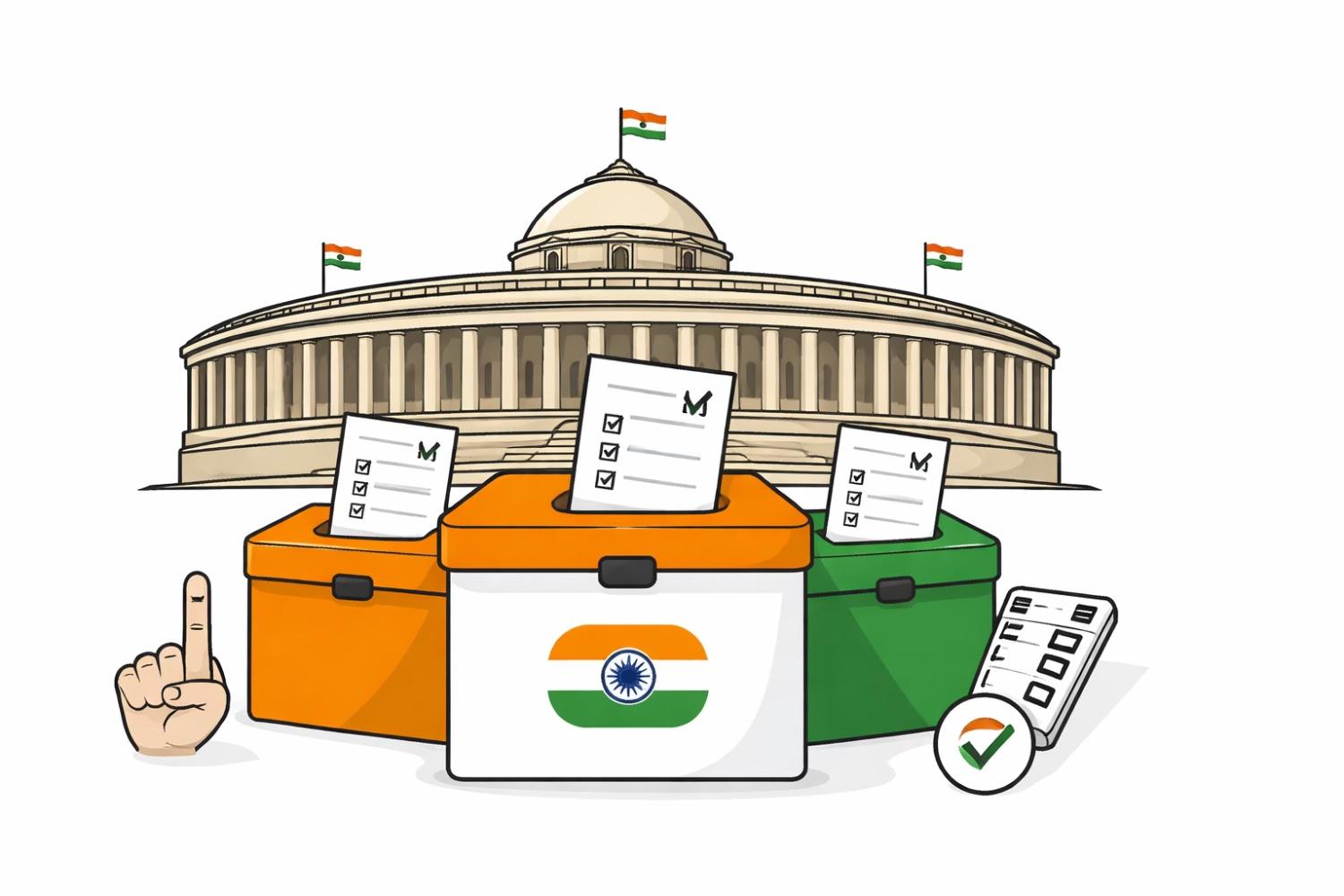
India’s Parliament is moving closer to examining one of the most debated electoral reforms in recent years — the proposal for “One Nation, One Election.” A Joint Parliamentary Committee (JPC) is expected to review the proposed bills that aim to hold Lok Sabha and state assembly elections at the same time across the country.
The move has sparked wide political and constitutional debate. Supporters say simultaneous elections could reduce government spending and improve governance. Critics argue that it may raise serious constitutional and federal concerns.
With the panel now set to examine the legislation, the discussion has entered a new stage in Parliament. Here is a detailed look at what the proposal means, why the bills are being reviewed, and the key constitutional issues involved.
Why the ‘One Nation, One Election’ Proposal Is Back in Focus
The idea of holding elections at the same time is not new in India. In the early years after independence, Lok Sabha and state assembly elections were held together between 1951 and 1967.
However, the cycle broke after several state assemblies were dissolved early due to political changes. Since then, elections have taken place at different times across states.
The current proposal aims to restore synchronized elections across the country.
Supporters believe this could address several issues such as frequent elections leading to repeated Model Code of Conduct restrictions, high election expenditure for governments and political parties, and continuous political campaigning that may affect governance.
The central government has argued that simultaneous elections may improve policy stability and administrative efficiency.
What the Joint Parliamentary Committee Will Do
The proposed Joint Parliamentary Committee (JPC) will examine the bills in detail before Parliament decides whether to pass them.
A JPC typically includes members from both the Lok Sabha and Rajya Sabha and represents different political parties.
Its role will be to study the constitutional and legal implications of the bills, consult constitutional experts, election officials, and legal scholars, review feedback from state governments and political parties, and recommend changes before the bills are finalized.
The committee process is important because the proposal could involve major constitutional amendments, which require broad political support.
What Changes the Proposed Bills May Require
Implementing simultaneous elections would require several constitutional and legal changes.
One major issue is the term of Lok Sabha and state assemblies. Currently, the Lok Sabha and state assemblies have a five-year term, but they can be dissolved earlier under certain circumstances. To synchronize elections, lawmakers may need to temporarily extend or shorten some terms so that election cycles align.
Experts also say several constitutional amendments may be necessary. These could involve provisions related to the duration of legislatures, dissolution of assemblies, emergency provisions, and election procedures.
Any constitutional amendment would require approval by two-thirds of members in Parliament, and some changes may also require ratification by at least half of the state legislatures.
The proposal may also require amendments to election laws such as the Representation of the People Act, which governs the conduct of elections in India and works in coordination with the Election Commission of India (ECI).
Major Constitutional Questions Being Debated
The review by the Joint Parliamentary Committee is expected to focus on several major constitutional questions.
What Happens If a Government Falls Early
One of the biggest challenges is what happens if a government loses its majority before the fixed election cycle ends.
Possible solutions discussed in policy debates include conducting mid-term elections only for the affected assembly or forming a temporary caretaker arrangement until the next synchronized election cycle.
However, legal experts say these options must be examined carefully to ensure that democratic representation is not weakened.
Can Assembly Terms Be Adjusted Legally
To align election cycles, some state assemblies may need to extend or shorten their current terms.
This raises legal questions because the Constitution provides for a five-year term for elected legislatures, except under specific circumstances such as a national emergency.
The committee will examine whether temporary adjustments can be made while staying within constitutional limits.
Does the Proposal Affect Federalism
India’s Constitution follows a federal structure, where both the Union government and state governments have defined powers.
Some political parties and constitutional scholars argue that synchronized elections could shift political debate toward national issues, possibly reducing attention on state-level concerns.
The committee will likely examine whether the reform could affect the balance between the Union government and the states.
How Will the Election Commission Manage Logistics
Holding nationwide elections for both Parliament and state assemblies at the same time would be a major logistical exercise.
Challenges could include managing electronic voting machines (EVMs) and VVPAT systems, deploying security personnel across many states simultaneously, and coordinating polling across a country with over 900 million eligible voters.
The Election Commission of India would play a central role in planning and executing such a nationwide exercise.
Supporters Say the Reform Could Save Money
Supporters of simultaneous elections argue that the reform could significantly reduce the cost of conducting elections.
Government spending and political campaign costs during elections often run into thousands of crores of rupees over multiple election cycles.
Frequent elections also mean repeated enforcement of the Model Code of Conduct, which can delay policy announcements and development projects.
Advocates say synchronized elections could reduce campaign spending, allow governments to focus more on governance rather than continuous campaigning, and provide more policy stability.
Critics Warn of Democratic and Practical Concerns
Opposition parties and several constitutional experts have expressed concerns about the proposal.
One concern is that fewer elections could reduce accountability, since voters would have fewer opportunities to evaluate governments.
Another concern involves the complex constitutional amendments required to implement the reform.
Experts have also pointed out the practical challenges of organizing simultaneous elections in a country as large and diverse as India.
Regional political parties have also raised concerns that national issues might dominate the electoral debate, potentially reducing the visibility of state-specific issues.
What Previous Committees and Studies Have Said
Several institutions have studied the feasibility of simultaneous elections in India.
Reports from bodies such as the Law Commission of India, parliamentary committees, and policy research organizations have examined the concept over the years.
Many of these studies concluded that while simultaneous elections may offer administrative and financial benefits, implementing the idea would require careful constitutional planning and strong political consensus.
What Happens Next in Parliament
The Joint Parliamentary Committee’s review is expected to take several months.
During this period, the panel may consult constitutional experts, legal scholars, political parties, and state governments to gather detailed views.
The committee will also review administrative, legal, and financial implications of the proposed reforms.
After completing its review, the panel will submit a detailed report to Parliament outlining its findings and recommendations.
Parliament will then decide whether to move forward with the legislation and proposed constitutional amendments.
Why the Debate Matters for India’s Democracy
The debate around “One Nation, One Election” goes beyond the timing of elections.
It raises broader questions about how India balances efficient governance, democratic accountability, and the federal structure of the Constitution.
For supporters, the proposal represents a step toward stability and administrative efficiency. For critics, it raises serious constitutional and democratic concerns that require careful examination.
As the Joint Parliamentary Committee begins its review, the outcome could influence how elections are conducted in India for decades.
The coming months will show whether the proposal gains the political support and constitutional clarity needed to move forward.
Disclaimer: The information presented in this article is intended for general informational purposes only. While every effort is made to ensure accuracy, completeness, and timeliness, data such as prices, market figures, government notifications, weather updates, holiday announcements, and public advisories are subject to change and may vary based on location and official revisions. Readers are strongly encouraged to verify details from relevant official sources before making financial, investment, career, travel, or personal decisions. This publication does not provide financial, investment, legal, or professional advice and shall not be held liable for any losses, damages, or actions taken in reliance on the information provided.
edited by D Rishidhar
About The Author