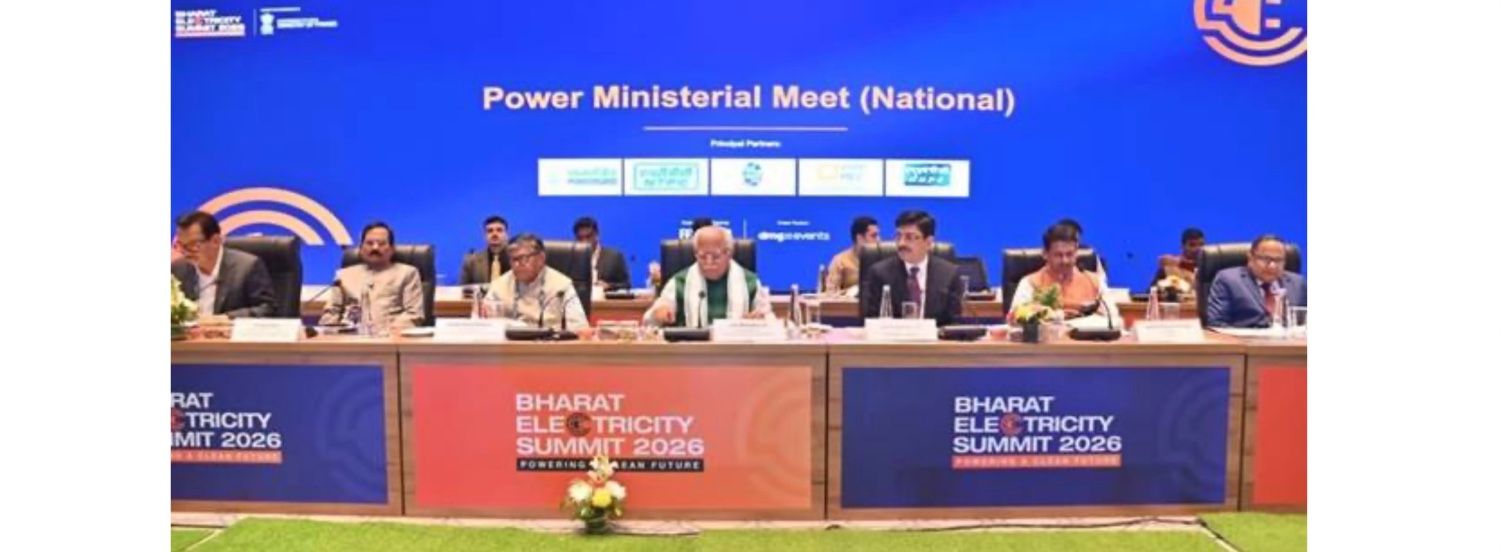
New Delhi, March 20, 2026: The Union Minister for Power, Shri Manohar Lal, chaired a high-level Ministerial Meeting with representatives from States and Union Territories on the sidelines of the Bharat Electricity Summit 2026, underscoring the need for coordinated action to strengthen India’s power sector and meet the country’s rapidly growing energy demands.
The meeting, held in New Delhi as part of the multi-day summit, brought together state power ministers, senior officials, and key stakeholders from across the electricity ecosystem. It served as a crucial platform for dialogue between the Centre and States on issues ranging from energy security and distribution sector reforms to the accelerating transition towards cleaner sources of power.
Addressing the gathering, the Power Minister highlighted that the electricity sector remains central to India’s development trajectory and will play a defining role in achieving the vision of “Viksit Bharat 2047.” He noted that India has made steady progress in expanding its installed capacity, improving power availability, and enhancing the overall reliability of supply. At the same time, he stressed that rising demand driven by industrial growth, urbanisation, and digital expansion necessitates forward-looking planning and stronger institutional coordination.
The Minister emphasised that energy security must remain a top priority, particularly in the context of global uncertainties affecting fuel supply chains and pricing. He called for a balanced energy mix that not only ensures reliability but also supports India’s climate commitments. In this context, he highlighted the importance of scaling up renewable energy capacity while also exploring emerging avenues such as nuclear power to ensure long-term sustainability and stability in the grid.
The discussions during the meeting also focused significantly on the performance of power distribution companies (DISCOMs), which continue to be a critical link in the electricity value chain. The Minister acknowledged the improvements made in recent years but noted that financial viability and operational efficiency remain areas requiring sustained attention. He reiterated the Centre’s commitment to supporting States through policy measures, reforms, and technological interventions aimed at strengthening the distribution segment.
Union Minister of State for Power and New & Renewable Energy, Shri Shripad Naik, who co-chaired the meeting, highlighted the growing role of advanced technologies in transforming the power sector. He pointed to the increasing deployment of smart meters and digital tools that enable better monitoring, improved billing efficiency, and enhanced consumer services. He also underlined the potential of artificial intelligence and data-driven systems in optimising grid management and forecasting demand patterns.
A key highlight of the meeting was the release of performance assessment reports for distribution utilities, reflecting the government’s continued focus on transparency and accountability. These reports evaluate utilities on a range of parameters, including consumer service delivery, operational efficiency, and financial performance. The findings indicate a gradual improvement in service standards and operational metrics, although variations persist across regions.
Participants in the meeting engaged in detailed discussions on the challenges faced by States and Union Territories, including issues related to infrastructure gaps, financial stress in utilities, and the need for faster adoption of clean energy technologies. There was broad consensus on the importance of collaborative efforts, policy alignment, and knowledge sharing to address these challenges effectively.
The Bharat Electricity Summit 2026, which has brought together policymakers, industry leaders, and experts from India and abroad, is emerging as a key forum for shaping the future of the country’s power sector. The Ministerial Meeting held during the summit reinforced the importance of cooperative federalism in driving sectoral reforms and ensuring that the benefits of reliable and affordable electricity reach every corner of the country.
As India moves towards becoming a $5 trillion economy and beyond, the outcomes of such high-level engagements are expected to play a crucial role in building a resilient, efficient, and sustainable power ecosystem capable of supporting long-term growth and development.
Source : PIB
edited by D.Rishidhar Reddy
About The Author