

The United States and Iran appear closer than they have been in years to reaching a temporary diplomatic breakthrough after reports emerged of a proposed “14-point memorandum of understanding” aimed at ending the current phase of conflict in the Middle East and reopening negotiations over Tehran’s nuclear programme.
According to multiple international reports, the draft proposal — described as a one-page framework document — could pave the way for broader negotiations involving sanctions relief, restrictions on uranium enrichment, maritime security in the Strait of Hormuz, and the release of billions of dollars in frozen Iranian funds.
While neither Washington nor Tehran has officially released the contents of the document, the emerging details suggest that both sides are attempting to avoid a deeper regional war while reviving a diplomatic channel that has remained largely frozen since the collapse of the earlier Iran nuclear agreement.
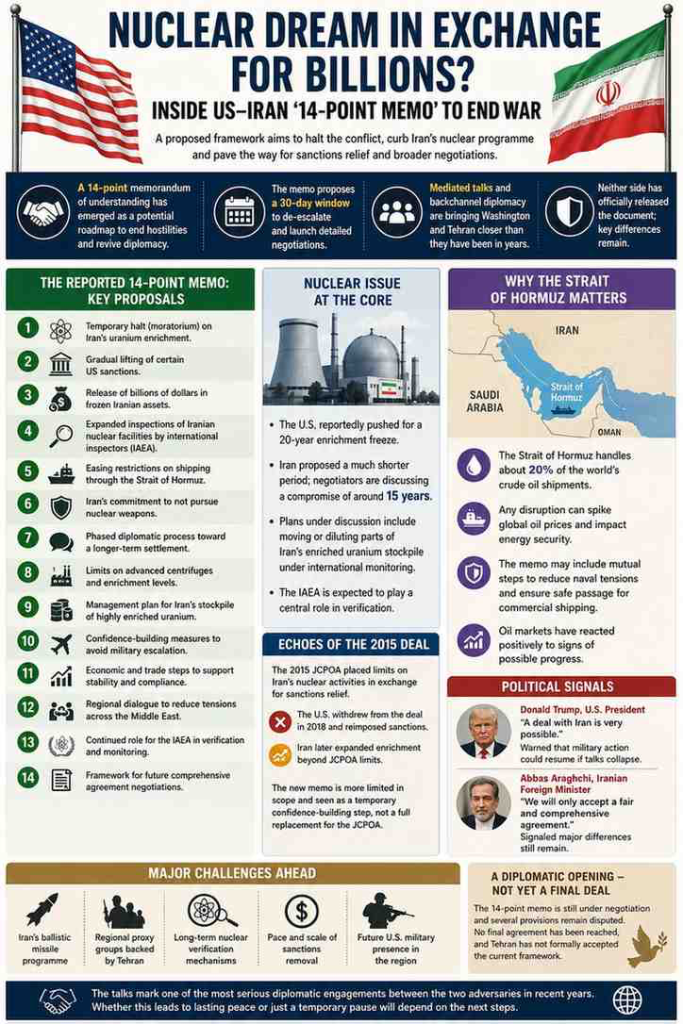
What Is the Reported 14-Point Memo?
The proposed memorandum is being described by US and international media as an interim political framework rather than a final treaty. Reports indicate the document contains 14 broad commitments intended to halt military escalation and create a 30-day window for more detailed negotiations.
Among the key proposals reportedly included are:
- A temporary halt or moratorium on Iran’s uranium enrichment programme
- Gradual lifting of certain US sanctions
- Release of billions of dollars in frozen Iranian assets
- Expanded international inspections of Iranian nuclear facilities
- Easing restrictions on shipping through the Strait of Hormuz
- Commitments from Iran against pursuing nuclear weapons
- A phased diplomatic process to move toward a longer-term settlement
The negotiations are reportedly being facilitated through mediators, including regional interlocutors, while senior US officials continue backchannel discussions with Iranian representatives. Reports suggest that both sides are “closer than at any point” since the latest conflict began, though major disagreements remain unresolved.
Nuclear Programme at the Heart of Negotiations
The core issue remains Iran’s nuclear ambitions.
Western governments, particularly the United States and Israel, have long argued that Iran’s enrichment activities could eventually provide the capability to build nuclear weapons. Tehran, however, maintains that its programme is intended for peaceful civilian purposes such as energy generation and medical research.
One of the biggest sticking points in the current negotiations reportedly concerns the duration of any enrichment freeze. According to reports, the United States initially pushed for a 20-year moratorium, while Iran proposed a much shorter period. Negotiators are now believed to be discussing a compromise lasting around 15 years.
Another major issue is Iran’s stockpile of highly enriched uranium. Reports suggest that one proposal under discussion would require Iran to move or dilute portions of its enriched uranium reserves under international monitoring.
International inspectors from the International Atomic Energy Agency (IAEA) are also expected to play a central role if a final agreement is reached.
Echoes of the 2015 Iran Nuclear Deal
The current discussions inevitably draw comparisons with the 2015 Joint Comprehensive Plan of Action (JCPOA), commonly known as the Iran nuclear deal.
Under the JCPOA, Iran accepted restrictions on its nuclear activities and intrusive inspections in exchange for sanctions relief from the United States, European Union, and United Nations.
However, the agreement began to unravel after the United States withdrew from the deal in 2018 and reimposed sanctions on Tehran. Iran later expanded enrichment activities beyond the original limits established under the pact.
The reported new memorandum appears more limited in scope and may serve as a temporary confidence-building arrangement rather than a full replacement for the JCPOA.
Analysts say Washington may now be prioritising immediate de-escalation and regional stability over a comprehensive long-term nuclear settlement.
Why the Strait of Hormuz Matters
Another important aspect of the talks involves maritime security in the Strait of Hormuz, one of the world’s most critical oil shipping routes.
The narrow waterway handles a significant portion of global crude oil trade. Any disruption there can immediately affect international energy prices and shipping markets.
Reports indicate the draft memorandum could include mutual steps to reduce tensions in the Strait, including easing naval restrictions and reducing threats to commercial shipping.
Global oil markets have already reacted positively to reports of possible progress in negotiations, reflecting investor hopes that a wider regional conflict may be avoided.
Trump Signals Optimism but Warns of Military Action
US President Donald Trump has publicly suggested that a deal with Iran is “very possible,” while simultaneously warning Tehran that military action could resume if negotiations collapse.
Iranian officials, meanwhile, have adopted a more cautious tone.
Iranian Foreign Minister Abbas Araghchi reportedly stated that Tehran would only accept a “fair and comprehensive agreement,” signalling that major differences still exist despite diplomatic momentum.
The gap between public rhetoric and private negotiations highlights the fragile nature of the current talks.
Regional and Global Implications
If the proposed memorandum succeeds, it could temporarily reduce tensions across the Middle East and lower fears of a wider regional confrontation involving Iran, Israel, and US forces stationed in the Gulf.
However, experts caution that even a signed memorandum would only represent an initial step.
Several unresolved issues remain highly sensitive, including:
- Iran’s ballistic missile programme
- Regional proxy groups backed by Tehran
- Long-term nuclear verification mechanisms
- The pace and scale of sanctions removal
- Future US military presence in the region
There are also domestic political challenges on both sides. Hardliners in Iran have historically resisted major concessions on nuclear policy, while critics in the United States argue that sanctions relief could strengthen Tehran economically without permanently ending its nuclear ambitions.
A Diplomatic Opening — Not Yet a Final Deal
Despite optimistic headlines, diplomats and analysts stress that no final agreement has been reached.
The reported 14-point memo is still under negotiation, and several provisions remain disputed. Multiple reports indicate Tehran has not formally accepted the current framework.
Still, the talks mark one of the most serious diplomatic engagements between the two adversaries in recent years.
Add indianewsjournal.in as a preferred source on google – click here
Edited By D.Rishidhar Reddy
About The Author


