

The political landscape of Tamil Nadu has entered a new and unpredictable phase after reports of a growing understanding between actor-turned-politician Thalapathy Vijay and Congress leader Rahul Gandhi. What initially appeared to be a tactical post-election arrangement is now being viewed as a larger political realignment that could reshape opposition politics in the state.
The emergence of Tamilaga Vettri Kazhagam (TVK) as a major force in the 2026 Tamil Nadu Assembly elections has disrupted the traditional DMK-AIADMK dominance. As coalition discussions intensified after the election results, Congress distancing itself from the DMK and moving closer to Vijay’s camp triggered intense political debate across the country.
While speculation around alliances often dominates Indian politics, several political signals indicate that the Vijay-Rahul Gandhi equation is not entirely sudden. The relationship appears to have evolved gradually through ideological overlaps, political positioning, and shared electoral calculations.
The Youth Factor Became the First Connecting Point
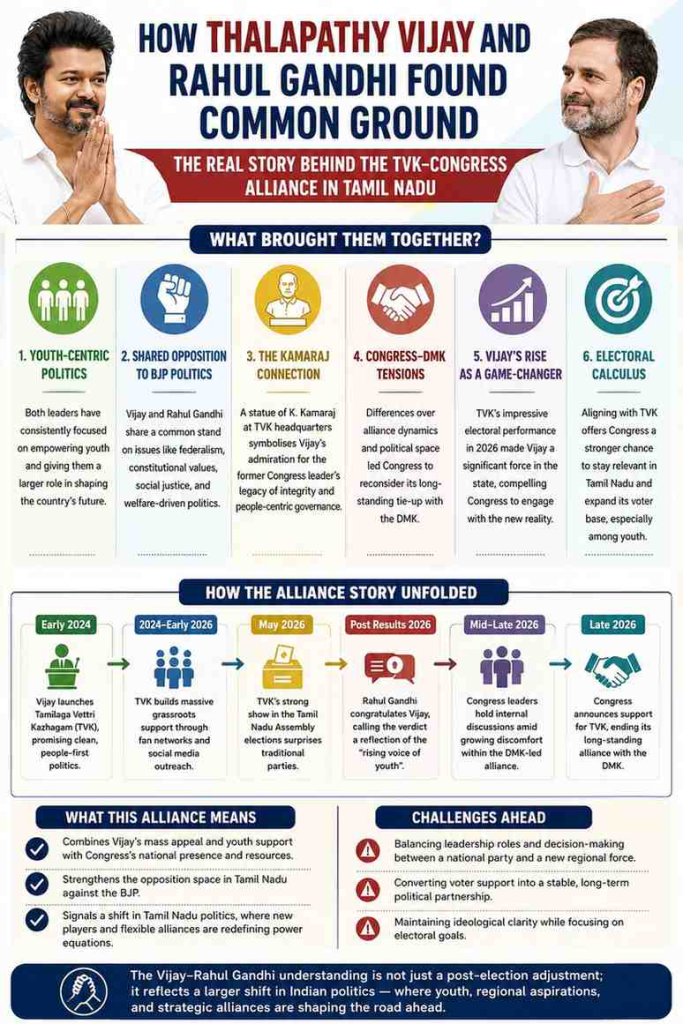
One of the clearest common themes between Vijay and Rahul Gandhi has been their repeated emphasis on youth-driven politics.
Soon after TVK’s strong performance in Tamil Nadu, Rahul Gandhi publicly congratulated Vijay and described the verdict as a reflection of “the rising voice of youth”. Political observers interpreted the statement as more than a routine congratulatory message. It was seen as an acknowledgment that Vijay had successfully tapped into a younger voter base that traditional parties were struggling to consolidate.
Vijay’s political rise has largely been powered by first-time voters, urban youth, fan-club networks, and digital mobilisation. Reports suggest TVK relied heavily on social media-driven campaigning rather than conventional political structures.
Rahul Gandhi, on the other hand, has spent recent years attempting to reposition Congress as a party that speaks to younger Indians through issues such as unemployment, education, economic inequality, and democratic participation. Analysts believe this overlap in messaging created a natural communication channel between the two leaders.
Shared Opposition Space Against BJP Politics
Another major factor behind the growing understanding appears to be national political arithmetic.
Though Vijay has projected TVK as an independent regional force, many of his public speeches have carried themes centred on constitutional values, federalism, social justice, and welfare politics — themes that also form the core of Congress’s national opposition narrative.
Congress, meanwhile, has been searching for credible regional allies after facing setbacks in multiple states. Tamil Nadu remained one of the few states where the party retained relevance through alliances. However, TVK’s rise changed the power balance dramatically after the elections.
Political analysts say Congress likely viewed Vijay as a leader capable of attracting voters beyond conventional caste and party lines, especially among younger demographics and neutral urban voters.
The Kamaraj Connection
An important symbolic aspect of the Vijay-Congress relationship is the legacy of K. Kamaraj, one of Tamil Nadu’s most respected Congress leaders.
According to reports, a statue of Kamaraj has been installed at TVK headquarters, reflecting Vijay’s admiration for the former chief minister’s governance model and public image.
Kamaraj remains a respected political figure across party lines in Tamil Nadu, known for his focus on education and welfare governance. Vijay invoking Kamaraj’s legacy signalled that TVK was trying to position itself not merely as a celebrity-driven movement, but as a party rooted in a broader social and governance vision.
For Congress, this symbolic alignment likely made political engagement with Vijay easier.
Congress-DMK Tensions Opened the Door
The Congress-TVK understanding also emerged against the backdrop of growing tensions between Congress and the DMK.
Reports indicate that Congress leaders were dissatisfied with their position within the DMK-led alliance structure. After the election results produced a fractured mandate, Congress eventually announced support for TVK, effectively ending its long-standing alliance with the DMK.
The shift marked one of the most significant political developments in Tamil Nadu in recent years. DMK leaders openly criticised Congress for backing Vijay’s party, accusing it of political opportunism.
However, Congress leaders argued that political realities had changed after TVK emerged as the single-largest force in the state. Some Congress functionaries even claimed that an earlier alliance with TVK could have produced an even stronger electoral outcome.
Vijay’s Rise Changed Tamil Nadu’s Political Equation
The scale of TVK’s electoral performance surprised many political observers.
Within a relatively short time after entering politics, Vijay managed to build a statewide organisation capable of competing with parties that have dominated Tamil Nadu for decades. Analysts say TVK’s success reflected widespread anti-incumbency sentiment and voter demand for political change.
Unlike traditional Dravidian parties, TVK’s campaign relied heavily on Vijay’s personal image, fan networks, and digital outreach.
This altered the state’s political equation significantly. Congress, facing declining independent influence in many states, may have concluded that aligning with a rapidly expanding regional force would offer better long-term political relevance than remaining dependent on older alliance structures.
Is This an Ideological Alliance or Electoral Pragmatism?
Despite growing cooperation, questions remain about whether the TVK-Congress relationship is based on deep ideological convergence or immediate political necessity.
TVK is still a relatively new political formation, and Vijay has attempted to maintain a carefully balanced image by avoiding rigid ideological labels. Congress, meanwhile, continues to operate as a national opposition party with broader national commitments.
At present, the alliance appears driven by a combination of practical politics and selective ideological overlap. Shared emphasis on youth participation, welfare politics, democratic institutions, and anti-BJP positioning has created enough common ground for cooperation.
However, the long-term stability of the relationship may depend on how power-sharing, leadership roles, and future electoral strategies evolve in Tamil Nadu.
What Happens Next?
With coalition discussions continuing and government formation talks still dominating headlines, the Vijay-Rahul Gandhi equation is expected to remain under national scrutiny in the coming weeks.
The Congress decision to move closer to TVK has already triggered debate within opposition circles, particularly regarding the future of the INDIA bloc and regional alliances. Political observers believe the Tamil Nadu developments could influence opposition strategies in other states as well.
For now, one thing is clear: the convergence between Vijay and Rahul Gandhi is not merely a sudden post-election adjustment. It reflects a larger shift in Indian politics where regional charisma, youth-driven mobilisation, and coalition compulsions are increasingly redefining political partnerships.
Add indianewsjournal.in as a preferred source on google – click here
Edited By D.Rishidhar Reddy
About The Author

